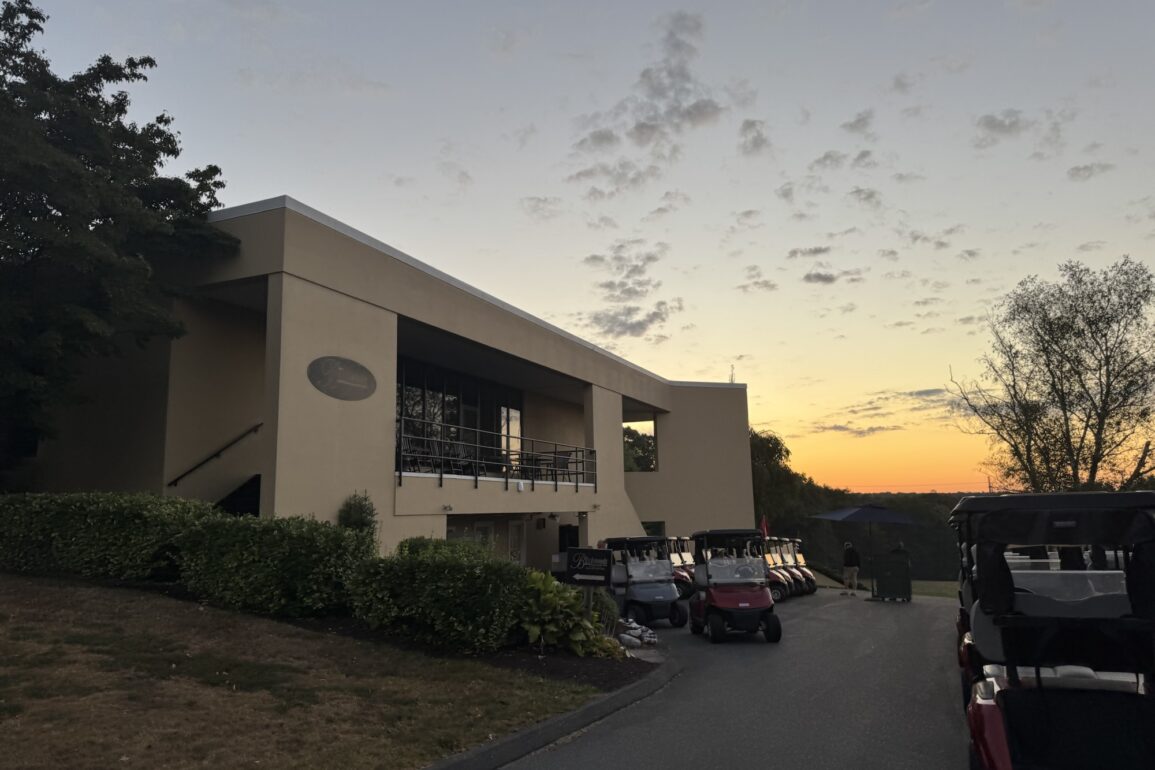
The Tradition Golf Club at Oak Lane is a public par-70 course measuring approximately 6,680 yards. The course was originally designed in 1960 by Geoffrey Cornish and is located in Woodbridge, Connecticut. The layout winds through gently rolling woodland, with tree-lined fairways and a peaceful, parkland setting that emphasizes straight drives and precise approaches. Greens are compact and subtly contoured, rewarding touch and course management. Ideal for players who value strategy over raw distance, the course offers a fair test for all skill levels.


Walkability
The routing here flows gracefully across gentle terrain, with no awkward climbs or distance gaps between green and tee. Despite being nearly 6,700 yards from the tips, the layout feels intimate and digestible on foot, likely occupying under 130 acres. The back-to-back transitions from Holes 5 to 6 and again from 8 to 9 are especially efficient. The paths are logical and understated, rarely forcing players to cross traffic or cart paths.
- Pro: I actually loved walking the course so much that I looped the front nine twice on a lazy, rainy day. The loop from Holes 1 through 9 clocks in at 3,325 yards—ideal for an unhurried two-hour stroll. Each hole flows naturally into the next, particularly the 3–4–5 stretch, where a long par 4 is followed by a short iron par 3 and another strong mid-length two-shotter. Each hole flows naturally into the next, particularly the 3–4–5 stretch, where a long par 4 is followed by a short iron par 3 and another strong mid-length two-shotter.
- Con: Some sections—particularly between Holes 14 and 15—feature wide, paved cart paths that run too close to the playing corridor and visually disrupt the experience. On foot, the walker is occasionally nudged onto hardscape where a grass path could easily suffice. At several junctions—particularly between Holes 14 and 15—cart paths could be rerouted slightly farther from the fairway corridors and given distinct walker-friendly spurs. Using crushed gravel for the pedestrian portion and adding low split-rail fences to visually and functionally separate cart and foot traffic would preserve the routing’s calm and improve flow. This minor realignment would reduce visual clutter and make the walk more immersive.
Strategic Test
Old Tradition won’t overwhelm you with drama, but there’s depth beneath its surface. Most holes offer two viable routes—especially the par 5s and the longer par 4s. Some fairways feature subtle crownings that favor one half of the corridor and challenge players to commit to an ideal angle. Still, a handful of holes would benefit from added incentive to take on risk.
- Pro: Hole 9 is a standout in terms of strategic architecture. This 490-yard par 5 bends gently to the left and sets up a meaningful decision from the moment you reach the tee. While the fairway is slightly crowned and tilts to the right, the real drama unfolds on the second shot. A creek cuts across the fairway about 50 yards short of the green, creating a pivotal decision point for all players. For the long hitter, a bold drive of around 260 yards sets up a tempting chance to go for the green in two. But to do so, the player must carry the creek with a high, controlled fairway wood or hybrid—typically 220+ yards—onto a slightly raised green protected by a false front. It’s a high-risk, high-reward play. A successful shot offers eagle chances, but a mishit brings water or a tricky recovery into play. For most players, the smarter move is to lay up short of the creek with a mid-iron or hybrid, leaving a third shot from roughly 90–110 yards. This approach demands distance control and spin, as the green’s contouring makes holding the surface a challenge if you’re out of position. The safest route avoids disaster but asks for consistent execution on the third shot to have any look at birdie. The brilliance of this hole lies in how it forces each player to weigh confidence against prudence. There’s no single “correct” path—just the one that fits your game and mindset at that moment. Whether you’re attacking or laying back, success depends on understanding your own tendencies and executing accordingly. That’s the essence of great strategy: choices that are fair, tempting, and consequential.
- Con: Hole 13—a 350-yard par 4—offers minimal strategic tension and plays almost entirely as a test of execution. It’s straight, flat, and largely devoid of visual shaping or positional nuance. The fairway is wide enough to remove concern off the tee, and the green complex does little to reward precise angles. A small center or offset fairway bunker and subtle contouring around the green—such as a swale or false edge—would introduce decisions and depth. Even a slight offset in the teeing ground to create a new visual line could force players to think differently. As it stands, success here is more about solid mechanics than intelligent play.
Playability
Old Tradition is broadly playable for high-handicap golfers, particularly due to its general lack of forced carries and ample fairway widths. The course design tends to favor straightforward lines and open entries into greens, allowing room for recovery and advancing the ball. However, inconsistency in green surrounds and rough management can create abrupt spikes in difficulty. Some holes appear designed with better players in mind and don’t provide alternate paths for shorter hitters or beginners.
- Pro: Hole 5—a 400-yard par 4—stands out as especially friendly to high-handicap players. The tee shot benefits from a wide corridor and gently sloped fairway that gathers shots back into play. The green is open in front and flanked by short grass, allowing bump-and-run or putter-based recovery for those who miss short. Its lack of lateral hazards means most misses are playable. It’s a well-paced breather that invites confidence.
- Con: Hole 16—a 430-yard par 4 from the back tees—is a grind for high-handicap players, even from the closest tees, which still measure 370 yards. It plays uphill into a narrow, tree-lined chute that magnifies the psychological pressure and physical toll. For shorter hitters, it takes two well-struck shots of 170+ yards just to reach the green fringe. There are no layup zones, no gathering contours—just a straight ask to hit two long, precise shots in succession. The green complex, slightly elevated and firm, offers little reward for a conservative approach, and players are often left scrambling just to stay on pace. There’s little opportunity for creativity or alternative play routes, which can feel stifling and demoralizing. The solution is modest: advance the forward tees to around 330 yards and shape the left side of the fairway into a shallow collection area to help gather weak drives. A low-profile fairway bunker 150 yards from the green could act as both visual target and strategic checkpoint. These changes would still require skill, but allow high-handicap players to experience flow rather than fatigue.
Atmosphere
Old Tradition’s setting is tranquil and occasionally charming, evoking a sense of calm more than spectacle. The property flows through tree-lined corridors with a low profile, allowing nature to frame rather than dominate the experience. Thoughtful touches—like mulch beds, mature maples, and softly graded tee surrounds—contribute to a cohesive aesthetic. You won’t find grand vistas, but you’ll find serenity.
- Pro: Hole 4—a 140-yard par 3—is a moment of true beauty and composure within the round. The tee shot plays across a still pond, requiring a full carry over water to a green framed by tall reeds and shaded tree canopy. On sunny mornings, the reflections of the flagstick and surrounding maples shimmer across the surface, making the scene feel almost theatrical. The soundscape—birds, breeze, and light ripples—invokes a meditative calm that contrasts wonderfully with the tension of the carry. What makes the hole especially memorable is how it combines aesthetic serenity with a touch of heroic drama. It’s a brief test of nerve, but one that rewards poise rather than power. In a course defined more by rhythm than spectacle, Hole 4 stands out as a visual and emotional anchor.
- Con: Some portions of the course—especially in the central corridor around Holes 2 and 13—can feel visually repetitive, as they share similar yardages and mostly straight or gently curving shapes with limited elevation variation. While the conditioning is strong, the visual language across these holes leans heavily on uniform tree-lined corridors without enough distinguishing features to make each hole feel distinct. The result is a segment of the round that fades in memory. To elevate these quieter moments, the course could benefit from site-sensitive architectural touches that enhance variety without disrupting cohesion. Consider low stacked stone walls behind a few greens, or shallow turf depressions flanking tee boxes to add rhythm. Split-rail fencing between transitions or vintage-style tee markers could lend nostalgic character. Adding native grasses and seasonal flower beds near walk-ons or green surrounds would inject subtle pops of color and ecological interest. Even a single signature element—like a sculptural tree or custom bench at a key turn—could serve as a visual anchor. These additions would make each hole feel more curated and intentional, helping the round unfold like a story rather than a sequence.
Final Word
Old Tradition occupies a thoughtful middle ground in the local golf landscape. It doesn’t deliver the heroic scale of Great River or the raw challenge of Shorehaven, but it quietly outpaces both in terms of routing logic and walkable charm. The course presents a compelling puzzle without relying on gimmicks—ideal for repeat play. While its flat terrain limits visual drama, the subtle slopes and strategic nuances reward players who plan rather than bash. Compared to Great River, which dazzles but can feel disconnected hole-to-hole, Old Tradition feels more cohesive and human-scaled. And unlike Shorehaven, which punishes off-days with relentless precision demands, Old Tradition gives players room to breathe and recover. It’s not a destination track, but it is a connoisseur’s loop—a place to sharpen your craft and settle your thoughts. I’ll return, not to chase a number, but to enjoy the rhythm of smart golf in a serene setting.

David is an avid golfer who loves walking Connecticut’s courses and playing alongside his family. He’s passionate about golf course architecture and one day hopes to play at Pebble Beach.