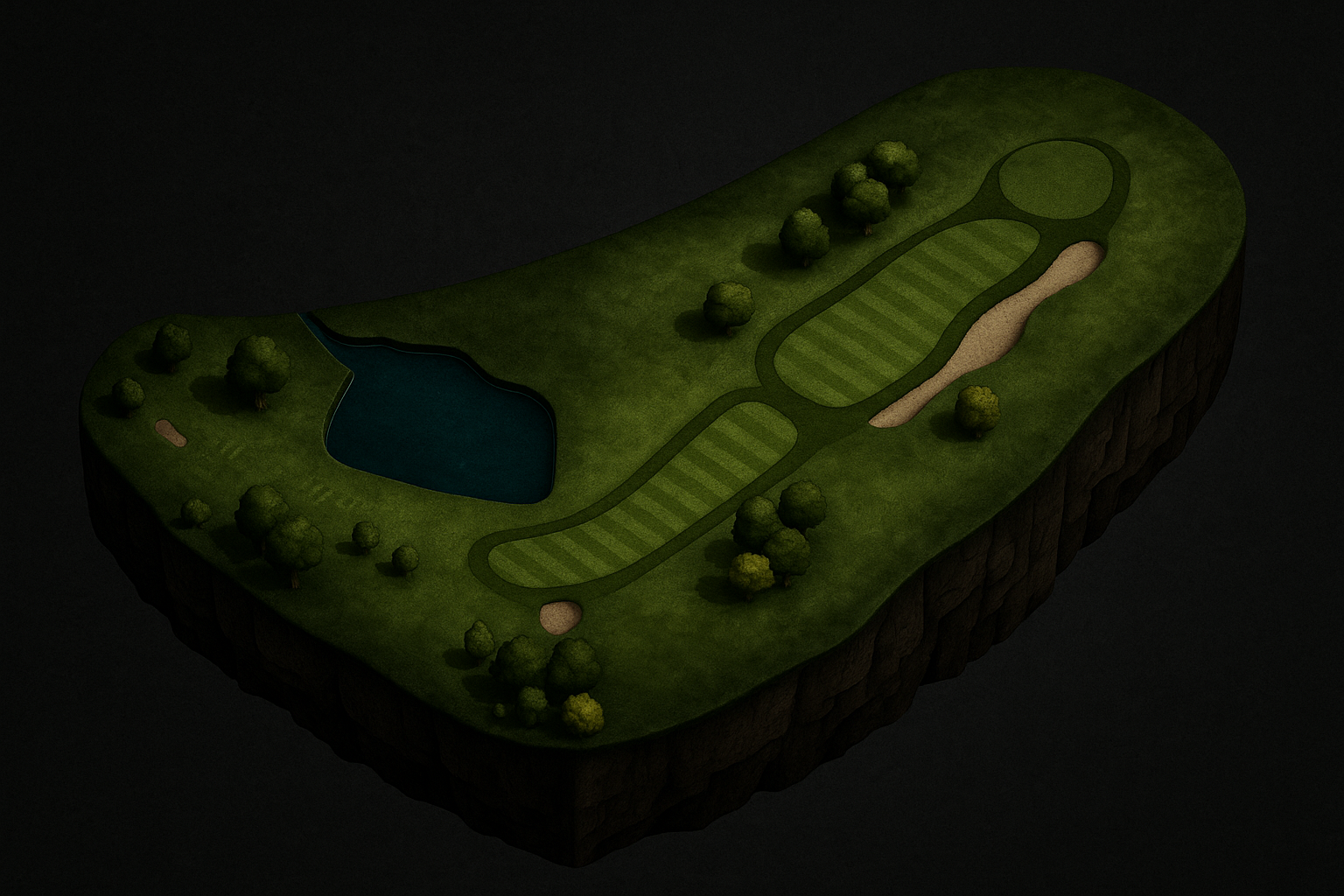
Whitney Farms is a public par-71 course measuring approximately 6,534 yards from the tips. The course was originally designed in 1981 by Hal Purdy and is located in Monroe, Connecticut.
Set on roughly 160 acres of gently rolling, wooded terrain in western Connecticut, Whitney Farms weaves through forest corridors, water hazards, and a handful of residential edges. The routing is relatively tight, with short green-to-tee transitions that help maintain a steady walking rhythm. While it doesn’t overwhelm with scale, the course delivers a steady mix of hole shapes, distances, and green complexes. Whether you’re walking nine or playing a full loop, Whitney Farms rewards placement, patience, and well-timed ambition.
Walkability
Whitney Farms is mostly walkable, aided by a compact routing and gentle elevation changes. Most green-to-tee walks are short, and only a few holes dip into more secluded parts of the property. Terrain slopes gradually, with only occasional climbs such as on holes 12. Players carrying bags or pushing carts should have minimal difficulty traversing the course. The middle of the round, especially holes 10–13, offers a particularly smooth and shaded walk.
- Pro: Holes 10–13 form an enjoyable loop in the southeast corner of the routing. Hole 10 (365 yards) plays flat and transitions directly into the par-5 11th (552 yards), then a short par 3 (150 yards) and a mid-length par 4 (368 yards). This section stays close to one axis of the property and is shaded, quiet, and flows beautifully underfoot.
- Con + Fix: Hole 17 (363 yards) is a confusing walk and an awkward hole. Despite being a dogleg right, it’s jammed between tee boxes and doesn’t present clear visual cues from the tee. Many players are unsure whether to lay up 240-250 yards to the left or aim longer down a narrow corridor. The spatial squeeze disrupts rhythm. Clearing some peripheral trees, repositioning teeing grounds, and adding a fairway aiming post or shallow centerline bunker would clarify intent.
Strategic Test
While not long, Whitney Farms demands smart decisions. Doglegs, water hazards, and well-placed bunkers create multiple moments where club selection and angle trump brute strength. Even the shorter par 4s require you to think ahead.
- Pro: Hole 18 (442 yards) is a strategic masterclass. From the elevated tee, players must decide between a bold carry over a pond to set up a short wedge approach or a conservative layup right of the pond to about 192 yards. The heroic line brings the pond into play and sets up a potential birdie chance, but the reward is complicated by a fronting bunker that makes controlling spin tricky. The safe layup avoids both the water and the bunker but leaves a substantially longer second shot with a more awkward angle. This classic risk-reward puzzle means that even seasoned players second-guess their strategy. It’s one of my all-time favorite holes for in-round debates—I remember yelling with friends, beers in hand, daring each other to go for it. That kind of emotional pull, rooted in solid architecture, is rare.
- Con + Fix: Hole 4 (174-yard par 3) is flat, featureless, and uninspired. With only basic front bunkering and a simple green, it lacks teeth or nuance. To add interest, the green could be re-contoured with a subtle false front and rear shelf, and the bunkers could be shifted to pinch both sides at mid-depth, forcing aerial precision.
Playability
The course is generally playable for mid- to high-handicappers. Wide fairways and simple green surrounds help limit big numbers. Trouble is present but usually visible, and most forced carries are manageable.
- Pro: Hole 7 (225-yard par 3) is daunting in distance but plays slightly downhill and features a forgiving front apron. High-handicappers can run shots up or miss right without severe penalty. It’s a long-iron test that feels fair, offering bailout space and a big target.
- Con + Fix: Hole 2 (405 yards) has a difficult forced carry of roughly 220 yards to reach an ideal landing zone. Many shorter players will struggle. Installing a forward tee at 300 yards and mowing a right fairway extension could give short hitters a playable path without watering down the hole’s challenge.
Atmosphere
Whitney Farms has a serene, wooded New England feel. The course is surrounded by mature trees and occasional water views, giving it a peaceful, tucked-away character. The routing flows through varied terrain without ever feeling disjointed.

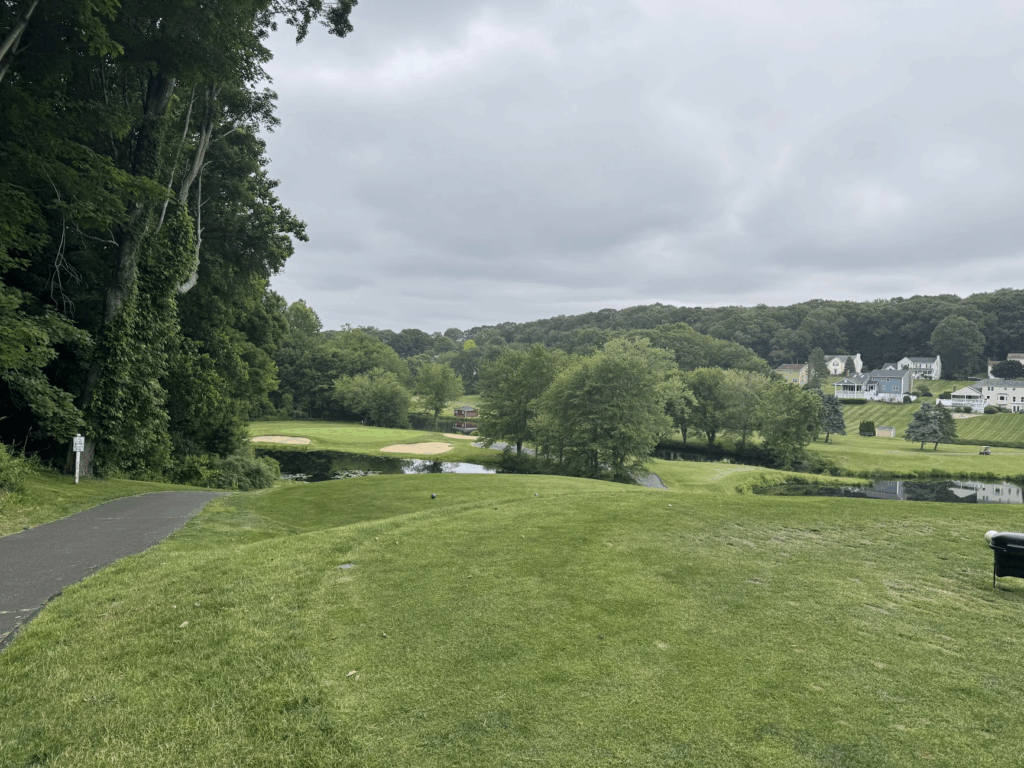
- Pro: Hole 15 (183-yard par 3) is one of the most beautiful shots I’ve seen. From a high tee box, you launch over a pond to a green flanked by bunkers. The adjacent pond on Hole 16 adds depth to the view. It’s cinematic golf—a true visual centerpiece.
- Con + Fix: Holes 1 and 2 don’t make a strong visual statement. They feel like transitional corridors, lacking memorable shaping or sightlines. Light tree clearing to open longer views, plus redesigned fairway bunkering to frame drives, could elevate the start and better set the tone.
Final Word
Whitney Farms is a course that rewards intellect over brawn. With tight corridors, sloped greens, and strategic hazards, it’s designed to make you think your way around. While it doesn’t stretch to great lengths, it consistently asks smart questions of the player—and rarely lets you coast.
Among its Fairfield County peers, Whitney Farms compares well in both scale and substance. Tashua Knolls offers a 27-hole layout stretching over 220 acres, with a large practice facility and a broader parkland feel. The Tradition at Oak Lane, by contrast, is an 18-hole course on a more compact 160-acre site known for walkability, tree-lined fairways, and consistently maintained greens. Whitney Farms also spans about 160 acres with 18 holes, but differentiates itself with more demanding angles, tighter driving zones, and green complexes that reward precise thinking. Its 6,534-yard routing is neither overpowering nor forgiving—it simply asks for well-planned execution.
For public-access golf in Fairfield County, Whitney Farms is an easy recommendation. It’s scenic, challenging, and thoughtfully built. I’ll absolutely be back—and I suspect many players who appreciate strategic golf will feel the same way.

David is an avid golfer who loves walking Connecticut’s courses and playing alongside his family. He’s passionate about golf course architecture and one day hopes to play at Pebble Beach.