If the Stack Speed Training System represents golf equipment pricing at its most absurd, then the B29 Blue Brick is running a close second. At $129 (marked down from $169—what a deal!), this “revolutionary” training aid is essentially a block of material with precisely angled holes drilled into it. That’s it. No electronics, no moving parts, no proprietary technology. Just a heavy base with some holes at specific angles that you stick alignment rods into.
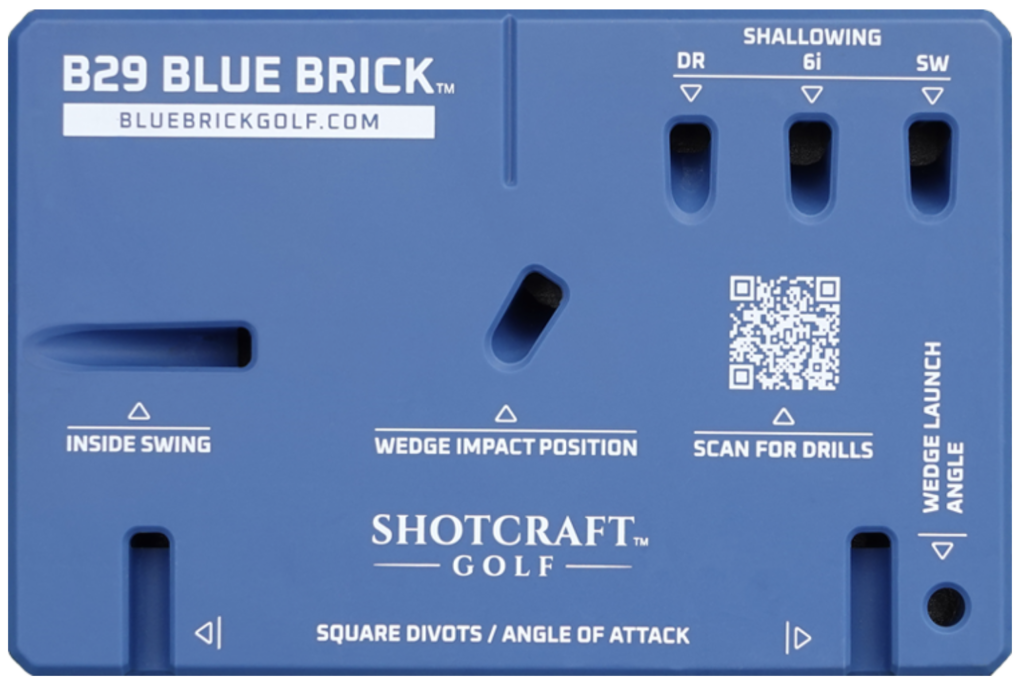
Let’s be absolutely clear about what you’re buying: a paperweight with engineering. Yes, the angles are based on tour player data. Yes, it’s heavier and sturdier than a 3D printed version. But at the end of the day, you’re being asked to pay $129 for something that costs under $10 in materials and can be replicated in an afternoon with basic tools or a 3D printer. The markup is staggering, and unlike the Stack system which at least pretends to offer an app ecosystem, the Blue Brick doesn’t even have that fig leaf to hide behind.
What You’re Actually Getting
The Blue Brick marketing describes it as an “11-in-1″ training system with slots for different clubs and swing functions. The weight specifications are 8.5″ x 5.5″ x 1.5”, weighing about 3 pounds, with a metal base plate for stability. It comes with two collapsible alignment sticks and access to instructional videos. The key selling point is that the angles are “precisely engineered” based on tour pro data—specifically, that tour pros shallow their downswing to approximately 60° with a 6-iron, 45° with a driver, and slightly steeper with wedges due to shorter shaft lengths.
Here’s the thing though: once you know these angles (which are now public knowledge thanks to their marketing), there’s nothing stopping you from creating your own version. The “proprietary” angles aren’t proprietary anymore—they’ve told everyone exactly what they are. A 60° angle for a 6-iron? Great, I can measure that. A 45° angle for driver? Noted. The entire value proposition collapses once you realize the “secret sauce” is just trigonometry that’s been published on their website and in every review.
Your Three Better Options
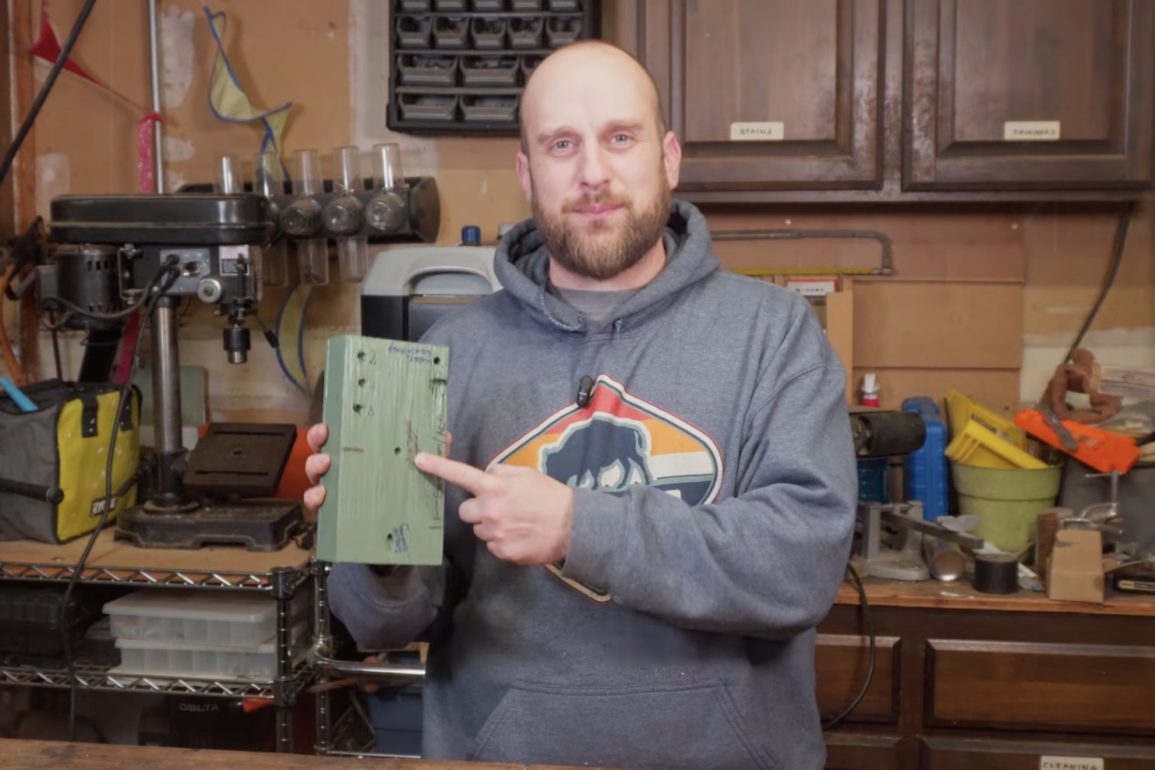
YouTube creator Matthew Ryan from Project Golf built his own Blue Brick for approximately $40, as documented in his video “I Built a $150 Golf Swing Trainer for $40.” His materials list includes a 2×6 board at least 8.5 inches long, four pieces of 8.5-inch flat bar (1 inch wide by 1/4 inch thick), two-part epoxy, paint, and two alignment sticks. The build process involves cutting the lumber to size, drilling holes at the correct angles (48°, 60°, and 70° for the various shallowing positions, plus additional angles for inside path and wedge work), attaching the flat bar pieces for weight and stability, and finishing with epoxy and paint. Total time investment: about 8 hours including design and measurement. Total cost: $40 including the alignment sticks.
| Material | DIY Cost | Blue Brick Cost |
|---|---|---|
| 2×6 lumber (8.5″ piece) | $3-5 | Included |
| 4x flat bar pieces | $15-20 | Included |
| Epoxy | $5 | N/A |
| Paint | $5-8 | N/A |
| 2 alignment sticks | $8-12 | Included |
| Total | $36-50 | $129 |
But here’s where it gets really interesting: the 3D printing community has completely reverse-engineered the Blue Brick and made it available for free. On MakerWorld, user_1419251669 uploaded a detailed 3D printable version with several key improvements over commercial alternatives. The design features a much larger base for stability, more area to fill with weighted material (sand, gravel, or Quikrete concrete mix), customizable hole sizes for different alignment stick diameters (7.8mm to 9.4mm in 0.1mm increments), and a secure bottom cover system using M4 threaded inserts and machine screws. The designer even included hole gauge models so you can test-fit your specific alignment sticks before committing to the final print.
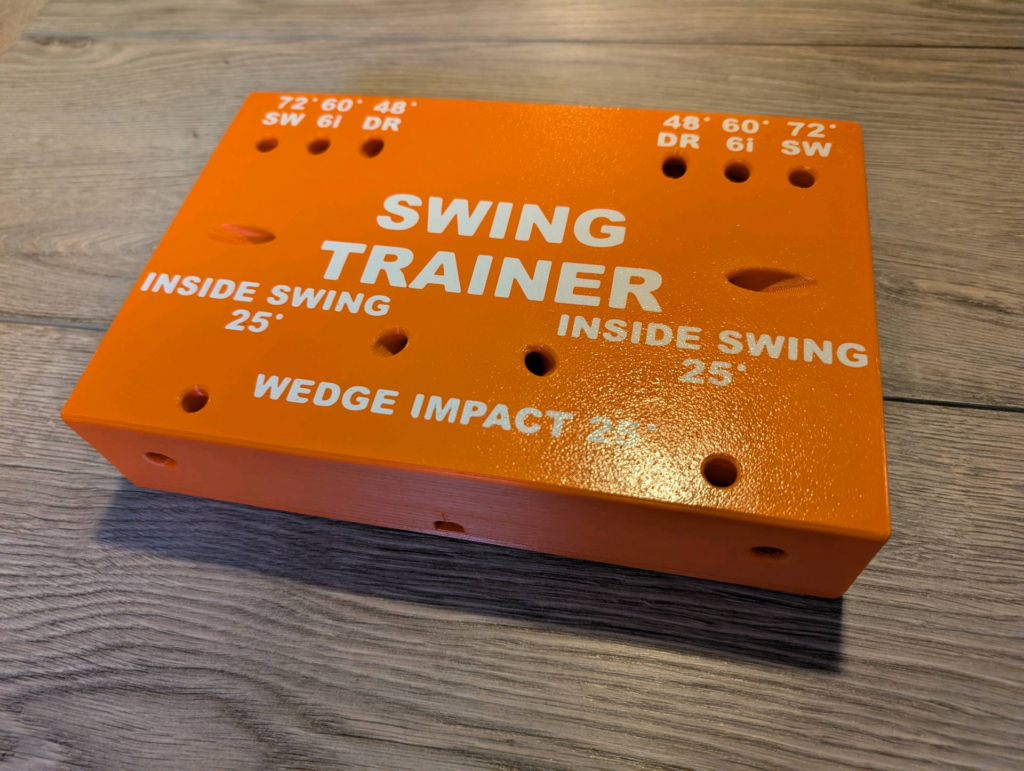
The MakerWorld model has received overwhelmingly positive reviews, with users reporting that it prints perfectly in 14-20 hours depending on settings, costs $5-15 in filament (PETG or PETG CF recommended for strength), and performs identically to the commercial Blue Brick. One reviewer noted: “printed perfectly. I made a few adjustments so the text was flat and I could print face down. no supports needed this way. I also replaced the screw holes with a plug and pin system. I filled the void with cat litter then glued the bottom on.” Another wrote: “Epic print. Came out great & fits my alignment sticks without the need for spacers.”
| Method | Cost | Time | Customization | Weight |
|---|---|---|---|---|
| Blue Brick (retail) | $129 | 0 (just buy it) | None | 3 lbs (fixed) |
| DIY Wood/Metal Build | $36-50 | 8 hours | Full control of angles | Customizable |
| 3D Print + Fill | $5-15 filament + $3-5 filler | 15-20 hours print + 1 hour assembly | Hole sizes, angles, text | Customizable |
Why DIY Is Actually Superior
Here’s what the Blue Brick marketing doesn’t want you to know: the fixed angles might not be optimal for your swing. Tour pros swing at approximately 60° with a 6-iron on average, but that’s an average across players with wildly different swing characteristics, body types, and club specifications. A 5’6″ player with a flat swing plane might benefit from different training angles than a 6’4″ player with a more upright swing. Juniors learning the game might need shallower angles to start. Players working on specific swing changes might need exaggerated angles beyond what the Blue Brick offers.
With DIY or 3D printed versions, you can customize everything. The MakerWorld model explicitly addresses this with adjustable hole sizes, but you could go further—drill additional holes at different angles, create slots for different training drills, add holes for other swing aids, or build multiple versions for different phases of your practice. Want to work on steeper angles for punch shots? Drill a hole at 70°. Want to train a super-shallow driver move? Add a 40° slot. The Blue Brick’s “11 functions” become 20 or 30 functions when you’re not constrained by their fixed design.
The weight customization matters too. The Blue Brick weighs 3 pounds with its metal base plate, which is fine for most situations but might be too light for hitting off real grass outdoors, or too heavy for carrying around in your bag every day. With a 3D printed version filled with concrete, you can make it 5 pounds for maximum stability. Or fill it halfway for portability. Or make two versions—one heavy for home practice, one light for the range. This kind of customization is impossible with the Blue Brick’s fixed weight.
The Real Cost Breakdown
Let’s be honest about what Blue Brick’s costs actually are. The injection molding cost for the base is probably $8-12 per unit at scale. The metal base plate adds another $3-5. Two cheap aluminum alignment sticks cost them maybe $4 wholesale. Packaging, shipping materials, and fulfillment might be $6-8. So their total cost per unit is somewhere around $21-29, and they’re selling it for $129. That’s a 400-550% markup, and while businesses need to make profit, this is excessive even by golf industry standards.
| Component | Blue Brick Cost (estimated) | Your DIY Cost | Your 3D Print Cost |
|---|---|---|---|
| Base structure | $8-12 (manufacturing) | $3-5 (lumber) | $5-15 (filament) |
| Weight system | $3-5 (metal plate) | $15-20 (flat bar) | $3-5 (concrete fill) |
| Alignment sticks (2) | $4 (wholesale) | $8-12 (retail) | $8-12 (retail) |
| Screws/inserts | $1 | $2 (M4 inserts/screws) | $2 (M4 inserts/screws) |
| Total | ~$21-29 | $36-50 | $18-34 |
| Retail Price | $129 | $36-50 | $18-34 |
To add insult to injury, they originally priced it at $169 before “discounting” to $129, a classic pricing psychology trick that makes you feel like you’re getting a deal when you’re actually just getting ripped off slightly less. The “60-day money back guarantee” is nice, but it’s also legally required in many jurisdictions and doesn’t cost them anything since the return rate on products like this is typically under 5%.
The Open Source Solution
The golf community has already solved this problem. The MakerWorld files are free and open source under a standard digital file license. The design has been downloaded thousands of times and refined through community feedback. Users have created variations with flat text that prints without supports, versions with plug-and-pin systems instead of screws, and adaptations for different printer sizes. This is exactly what should happen with overpriced golf equipment—the community reverse-engineers it, improves it, and makes it available to everyone.
For those without 3D printers, many public libraries now offer 3D printing services for $1-2 per hour of print time. Makerspaces and community workshops are another option. Or you can order prints from online services for $15-25. Even paying someone else to print it for you is still cheaper than buying the Blue Brick, and you get the satisfaction of supporting makers instead of enriching a company that’s charging $90 for labor that a CNC machine performs in 10 minutes.
The beauty of the 3D printed approach is the rapid iteration. Don’t like how the first one turned out? Print another one with modifications. Want to try different hole angles? Edit the file and print. Alignment stick doesn’t fit quite right? Adjust the hole diameter by 0.2mm and print again. This kind of experimentation would cost you $129 every time with the Blue Brick, but costs you $5 in filament with a 3D printer. Over the course of perfecting your training aid, you could easily save $500+ in iteration costs alone.
Why This Pricing Is Indefensible
The Blue Brick markets itself as a tool designed by Golf Digest instructor Clay Ballard, and while his credentials are legitimate, the implication that this justifies the price is laughable. The design work happened once. The angle research happened once. The development of the instructional videos happened once. These are fixed costs that get amortized over thousands of units sold. After the first 100 units, every single Blue Brick sold is nearly pure profit minus the minimal per-unit manufacturing cost.
Compare this to actual high-tech training aids with real development costs—launch monitors with doppler radar systems, putting mirrors with laser alignment, swing analyzers with accelerometers and gyroscopes. These products have ongoing component costs, firmware development, app maintenance, and genuine engineering complexity. The Blue Brick has drilled holes. It’s not even in the same category, yet they’re pricing it like it contains sophisticated electronics.
The argument that you’re paying for “precisely engineered angles based on tour data” falls apart when you realize those angles are now public information that anyone can replicate. It’s like trying to charge $100 for a recipe after you’ve already published the recipe in the product description. Once the specifications are known, the value proposition evaporates for anyone with basic tools or access to a 3D printer.
If you want a Blue Brick-style training aid, you have three vastly superior options: build one from lumber and flat bar for $36-50 in an afternoon, 3D print one for $18-34 using the free MakerWorld files, or pay someone to 3D print one for you for $30-40. All three approaches give you customization options the Blue Brick can’t match, and all three cost a fraction of the $129 retail price. The golf industry’s pricing model desperately needs disruption, and the Blue Brick is exhibit B right after the Stack system.
What other training aids are ridiculously overpriced? Drop a comment below—let’s build a complete DIY alternative list.

David is an avid golfer who loves walking Connecticut’s courses and playing alongside his family. He’s passionate about golf course architecture and one day hopes to play at Pebble Beach.