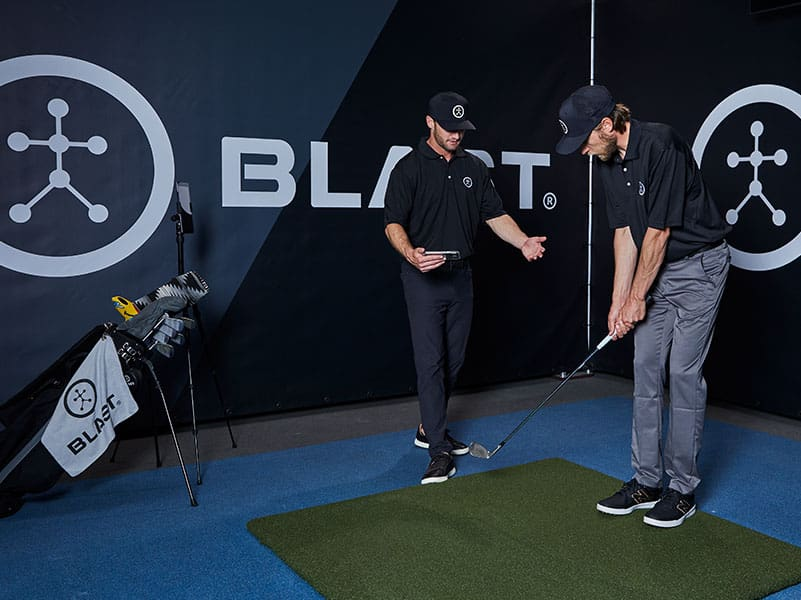
I genuinely love the concept behind the Blast Motion golf sensor. The idea of democratizing swing analysis through an affordable, portable device that clips onto any club is exactly the kind of innovation golf needs. Being able to track your practice sessions, monitor swing changes over time, and get immediate feedback without booking time on a $30,000 TrackMan is compelling for golfers at every level.
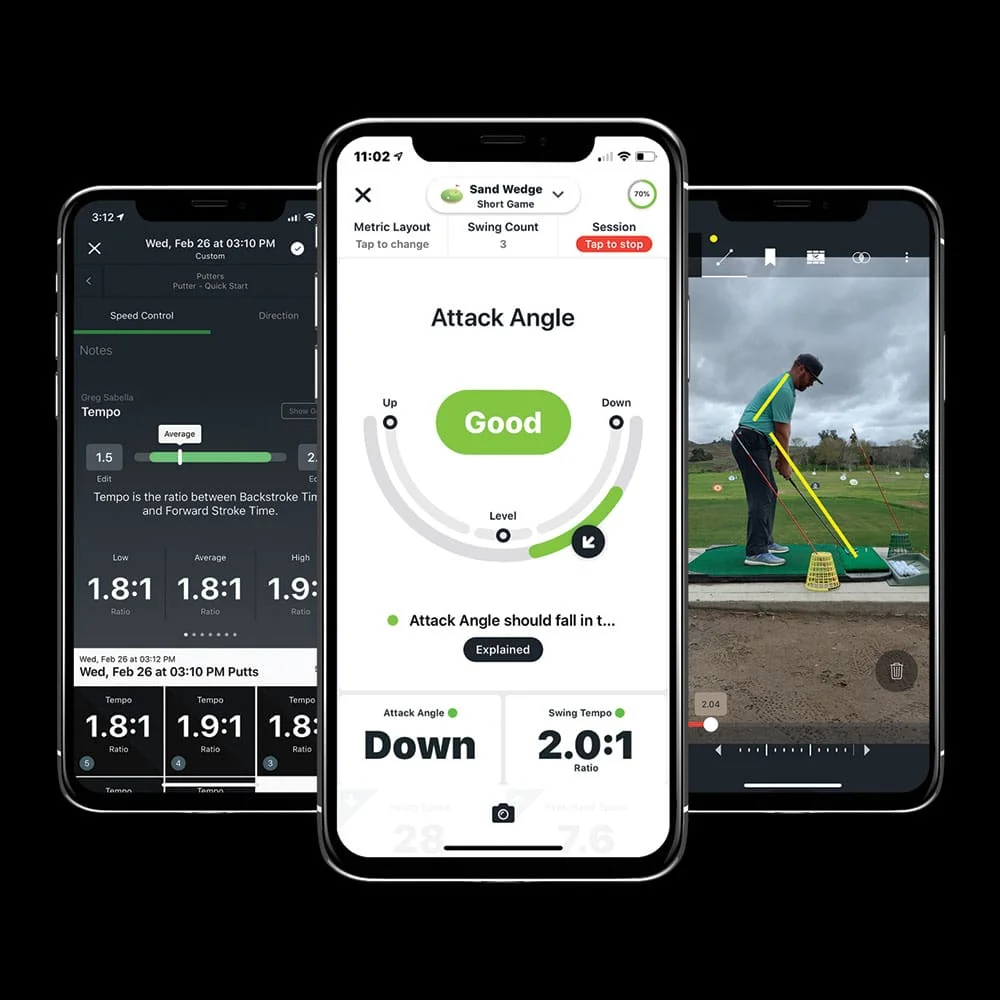
However, after extensive testing against TrackMan validation and examining the underlying physics of how grip-mounted sensors work, it’s clear that Blast Motion needs to provide far more transparency about the variance of their measurements—particularly when using different clubs with different shaft characteristics. The technology is solid for certain applications, but golfers deserve to understand the accuracy limitations before relying on the data for equipment decisions or swing changes.
What Blast Motion Measures
The Blast Motion sensor is a six-axis Inertial Measurement Unit (IMU) containing a three-axis accelerometer and three-axis gyroscope. Mounted at the butt end of the grip, it records angular velocity and linear acceleration throughout the swing. The device then applies proprietary algorithms to calculate various swing metrics:
| Metric | Description | Measurement Type |
|---|---|---|
| Club Head Speed | Speed of club head at impact | Calculated (claimed ±1 mph) |
| Backswing Time | Duration from takeaway to top | Direct measurement |
| Downswing Time | Duration from transition to impact | Direct measurement |
| Tempo | Ratio of backswing to downswing time | Direct measurement |
| Time to Impact | Total swing duration | Direct measurement |
| Attack Angle | Vertical approach angle at impact | Calculated estimate |
| Swing Plane | Club path through the swing | Calculated estimate |
The key distinction is between direct measurements and calculated estimates. Unlike launch monitors that directly measure club head speed via Doppler radar (TrackMan, FlightScope) or high-speed cameras (GCQuad, Foresight), Blast Motion must calculate what’s happening 40+ inches away at the club head based on measurements taken at the grip.
The Fundamental Accuracy Problem
Why Grip-Mounted Sensors Can’t Accurately Measure Club Head Speed
The physics here are unforgiving. To calculate club head speed from grip-end measurements, Blast Motion must:
- Integrate angular velocity data over time to determine shaft rotation
- Apply assumptions about shaft length and flex characteristics
- Account for shaft deflection and lag during the downswing
- Estimate the complex three-dimensional path of the club head
Each step introduces cumulative error. The most problematic is shaft behavior. During the downswing, a golf shaft isn’t a rigid rod—it’s a complex dynamic system that bends, twists, and exhibits different flex profiles depending on load, torque, and the player’s release pattern. The same grip rotation can produce vastly different club head speeds depending on shaft characteristics and swing dynamics.
TrackMan Validation Testing
To understand Blast Motion’s real-world accuracy, I tested it alongside TrackMan 4’s speed training function and also validated against the Superspeed doppler radar system. Both are considered gold standards for club head speed measurement.
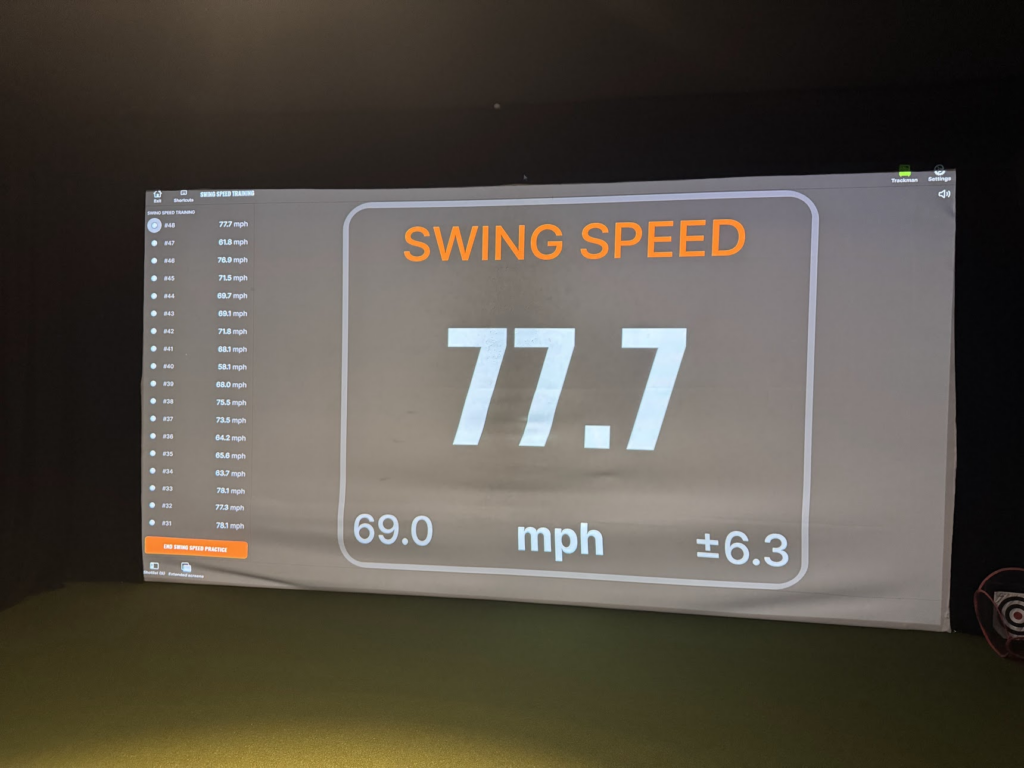
The results showed considerable variance across multiple clubs and swing speeds. Blast Motion consistently underestimated club head speed by 2-4 mph compared to both TrackMan and Superspeed, with the discrepancy increasing on longer clubs (driver showing the largest gap). More concerning was the swing-to-swing consistency—while TrackMan showed standard deviations under 1.2 mph, Blast Motion exhibited nearly double that variability.
This isn’t just random noise. It’s systematic bias stemming from the fundamental challenge of calculating club head behavior from grip-end measurements, compounded by different shaft characteristics across clubs.
The Critical Need for Transparency on Club-to-Club Variance
Here’s where Blast Motion falls short on consumer disclosure: they don’t adequately communicate how measurement accuracy varies dramatically across different clubs and shaft configurations. The ±1 mph accuracy claim appears prominently in marketing materials, but there’s no asterisk explaining that this only applies under specific conditions with specific shaft types.
The reality is that accuracy depends heavily on multiple variables:
| Factor | Impact on Accuracy |
|---|---|
| Shaft Length | Longer shafts (45″+ driver) introduce more integration error than shorter shafts (35″ wedge) |
| Shaft Flex | Regular flex deflects differently than extra stiff, changing grip-to-clubhead relationship |
| Shaft Weight | Lightweight graphite (50-60g) vs. steel (120-130g) affects loading patterns |
| Kick Point | Low kick shafts bend differently than high kick, altering energy transfer timing |
| Release Pattern | Early releasers vs. late releasers create different shaft loading profiles |
| Swing Speed | Higher speeds amplify shaft deflection and magnify measurement errors |
Blast Motion should provide accuracy specifications for each club type. Something like:
| Club Type | Typical Variance vs. Radar |
|---|---|
| Driver (graphite, regular-stiff flex) | ±2-4 mph |
| Fairway Woods | ±2-3 mph |
| Long Irons (graphite) | ±2-3 mph |
| Mid Irons (steel) | ±1.5-2.5 mph |
| Short Irons/Wedges (steel) | ±1-2 mph |
They should also disclose that swing-to-swing precision is lower than radar systems. If you’re testing different driver shafts and see a 2 mph difference between them with Blast Motion, you can’t confidently say whether one shaft actually produces more speed or if you’re seeing measurement noise.
More importantly, Blast Motion should provide users with a calibration protocol: “Take 10 swings with your driver on a TrackMan or GCQuad. If Blast Motion reads 3 mph slow on average, you can apply a +3 mph correction factor for that specific club.” This would at least give users accurate relative feedback with their own equipment.
The current approach—presenting the data as universally accurate across all clubs and configurations—sets unrealistic expectations and can lead golfers to make poor equipment decisions based on systematically biased measurements.
What Blast Motion Measures Accurately
It’s worth noting that Blast Motion’s timing-based metrics are genuinely accurate. Backswing time, downswing time, and tempo ratios don’t require calculating what’s happening at the club head—they’re based purely on grip rotation rates, which the IMU measures directly.
For golfers working on tempo consistency (maintaining a 3:1 backswing-to-downswing ratio, for example), Blast Motion provides reliable, actionable feedback. These measurements showed excellent correlation with video analysis timing and are probably the sensor’s most valuable output for serious practice.
How to Improve Measurement Accuracy: Engineering Solutions
Solution 1: Club Head-Mounted IMU for Direct Measurement
The most direct path to accuracy is measuring at the point of interest. A club head-mounted IMU would eliminate all shaft deflection variables and provide direct measurements of:
- Club head speed (actual, not calculated from grip rotation)
- Attack angle (precise vertical approach path)
- Club path (true swing direction through impact)
- Face angle at impact (critical for ball flight prediction)
- Acceleration profile through the impact zone
- Impact location detection (center vs. toe/heel strikes)
Engineering Challenges:
- Extreme g-forces – The club head experiences 1,000+ Gs during the downswing and 3,000-4,000 Gs at ball impact, requiring ruggedized sensors rated for high-shock environments
- Weight constraints – Adding even 10-15 grams to the club head affects swing weight and feel; sensor package must be <5g
- Power management – Battery must survive thousands of swings in a compact, lightweight package
- Data transmission – Bluetooth signal integrity during high-speed rotation presents challenges
- Durability – Housing must withstand repeated impacts without affecting club performance
- Installation – Retrofitting existing clubs becomes impractical; would require selling integrated club heads or complete clubs
Potential Implementation:
A club head sensor could be embedded in the back cavity of irons or in the crown/sole of woods. Modern composite construction techniques allow for small sensor pockets that don’t compromise structural integrity. The sensor would transmit data post-swing to a grip-mounted receiver/battery pack that handles communication and charging.
Accuracy improvement: This approach could achieve ±0.5 mph accuracy, comparable to camera-based launch monitors, because it eliminates all shaft-related variables.
Solution 2: Standardized Club System
A more practical near-term solution: pair the grip-mounted sensor with a standardized shaft whose flex characteristics are precisely known and calibrated.
How It Would Work:
- Blast Motion provides a calibrated reference shaft (or several for different swing speeds)
- Shaft specifications (length, flex profile, torque, weight) are precisely measured and encoded in the sensor firmware
- Algorithms are optimized specifically for this known shaft’s deflection behavior
- Users attach their driver/iron heads to the standard shaft for measurement sessions
- System could include multiple shafts: driver length, iron length, wedge length
Accuracy Benefits:
- Eliminates shaft variability as primary error source
- Allows algorithms to model exact deflection patterns under load
- Could reduce club head speed error from ±3-4 mph to ±1 mph or better
- Maintains affordable grip-sensor technology (no expensive club head sensors)
- Provides consistent baseline for tracking improvement over time
Practical Considerations:
- Less convenient than universal clip-on approach
- Requires users to swap club heads (only works with removable hosels)
- Doesn’t measure performance with your actual gamer shafts
- Need to calibrate for different head weights (200g driver vs. 250g iron)
Implementation Path:
Blast Motion could offer a “Pro Accuracy Kit” that includes the sensor plus 2-3 calibrated shafts at different lengths. Users would get precise measurements for general swing development, then occasionally validate their game clubs on a launch monitor to understand real-world performance differences due to their specific shaft setups.
Accuracy improvement: With optimized algorithms for a known shaft, this could achieve ±1 mph accuracy, a significant improvement over current ±3-4 mph variance.
Solution 3: User Calibration and Enhanced Algorithms
The most immediately implementable improvement: leverage software updates to reduce systematic errors through better modeling and personalized calibration.
User Calibration Protocol:
- Initial setup requires 10-20 swings on a validated launch monitor (TrackMan, GCQuad, etc.)
- App collects paired data: Blast Motion measurements + verified club head speeds
- Algorithm generates club-specific and player-specific correction factors
- System learns your release pattern, shaft loading characteristics, and swing dynamics
- Periodic re-calibration recommended (quarterly or when changing equipment)

Enhanced Shaft Modeling:
- Detailed shaft database with flex profiles for common models (Fujikura, Project X, KBS, etc.)
- Users input specific shaft information: manufacturer, model, flex, length, weight
- Algorithms apply shaft-specific deflection models instead of generic assumptions
- Accounts for differences between graphite vs. steel, high vs. low kick point, etc.
Machine Learning Refinement:
- Train neural networks on large datasets of paired grip-sensor + launch monitor measurements
- Learn patterns in how different shaft types, swing speeds, and release timings affect grip-to-clubhead relationships
- Continuously improve algorithms as more users contribute calibration data
- Implement adaptive models that refine accuracy as they collect more swings from each individual user
Real-Time Confidence Intervals:
- Display measurement uncertainty with each reading (e.g., “106 mph ±2 mph”)
- Wider intervals for unfamiliar shaft types or unusual swing patterns
- Narrower intervals after calibration with validated equipment
- Helps users understand when measurements are reliable vs. when to seek verification
Accuracy improvement: User calibration could reduce mean error from 3-4 mph to under 1 mph for calibrated clubs. Enhanced algorithms and shaft modeling could reduce swing-to-swing variance from 2+ mph to 1-1.5 mph, approaching the precision of radar systems while maintaining the convenience of grip-mounted sensors.
Comparing the Three Approaches
| Solution | Accuracy & Difficulty | Cost & Convenience |
|---|---|---|
| Club Head-Mounted IMU | ±0.5 mph accuracy (best) Very high implementation difficulty | Significant cost increase Low convenience (requires integrated clubs) |
| Standardized Calibration Shaft | ±1 mph accuracy (good) Medium implementation difficulty | Moderate cost increase Medium convenience (requires club swapping) |
| User Calibration + ML | ±1-1.5 mph accuracy (good) Low implementation difficulty | Minimal cost increase High convenience (one-time setup) |
Recommendations for Blast Motion Users
If you currently own or are considering Blast Motion, here’s how to get the most accurate and useful data:
Appropriate Use Cases
| Use Case | Blast Motion Suitable? | Notes |
|---|---|---|
| Tempo and timing work | ✓ Excellent | Direct measurements are highly accurate |
| Tracking speed improvements over time | ✓ Good | Relative changes are reliable even if absolute values are off |
| Practice motivation and gamification | ✓ Good | App interface makes practice engaging |
| Shaft fitting and comparison | ✗ Poor | Variance too high to detect 1-2 mph differences reliably |
| Equipment decision-making | ✗ Poor | Systematic bias makes absolute values unreliable |
| Comparing to tour averages | ✗ Poor | Need calibration against verified system first |
| General swing monitoring | △ Fair | Useful after establishing personal baseline |
Validate Your Baseline
Take your Blast Motion to a facility with TrackMan or GCQuad. Hit 10 swings each with your driver, 7-iron, and wedge. Note the systematic difference between the two systems. If Blast consistently reads 3 mph slow with your driver, you can mentally add 3 mph to future readings with that specific club and shaft combination.
Focus on Relative Changes
Even if absolute speeds are off, Blast Motion can reliably track whether you’re gaining or losing speed over time. If your readings go from 104 mph to 107 mph over three months of training, you’ve genuinely gained speed—even if your actual speeds were 108 mph and 111 mph.
Use Timing Metrics Extensively
The tempo, backswing time, and downswing time measurements are highly accurate and valuable for swing development. These metrics show excellent correlation with high-speed video analysis and can help you build consistency in your swing timing.
Calibrate for Equipment Decisions
Never rely solely on Blast Motion for shaft fitting or equipment comparisons. If testing two driver shafts and see a 2 mph difference, you’re within the measurement error. Get those decisions validated on a professional launch monitor where you can trust 1 mph differences.
Track Swing Changes Carefully
When working on swing modifications, take multiple swings (20+) before and after changes to overcome measurement variance. Statistical averaging helps separate real changes from noise.
Final Thoughts
I genuinely appreciate what Blast Motion is trying to accomplish. Making swing data accessible to everyday golfers without requiring $30,000 launch monitors or $200/hour facility time is important for the game’s growth and development. The technology is clever, the app is well-designed, and for certain applications—especially tempo and timing work—it delivers real value.
But Blast Motion needs to be more transparent about measurement accuracy, particularly how variance changes across different clubs and shaft types. Golfers deserve to know that the ±1 mph accuracy claim comes with significant caveats. They should understand that a grip-mounted sensor fundamentally cannot match the precision of direct measurement systems.
The three solutions I’ve outlined—club head mounting, standardized calibration shafts, and enhanced user calibration—all represent viable paths to improved accuracy. The engineering challenges are real but not insurmountable. With modern IMU technology, machine learning algorithms, and thoughtful calibration protocols, grip-mounted sensors could achieve accuracy levels that make them genuinely useful for equipment fitting and detailed swing analysis.
Until those improvements arrive, I recommend using Blast Motion for what it does well: tracking practice volume, monitoring tempo consistency, and providing general feedback on swing trends. Validate your baseline against TrackMan, understand the limitations, and supplement with periodic launch monitor sessions when you need precise data for equipment or swing decisions.
The concept is sound. The execution needs refinement. With greater transparency and some engineering investment in improved accuracy, Blast Motion could evolve from a practice motivation tool into a genuinely reliable measurement system that golfers can trust for critical decisions.

David is an avid golfer who loves walking Connecticut’s courses and playing alongside his family. He’s passionate about golf course architecture and one day hopes to play at Pebble Beach.