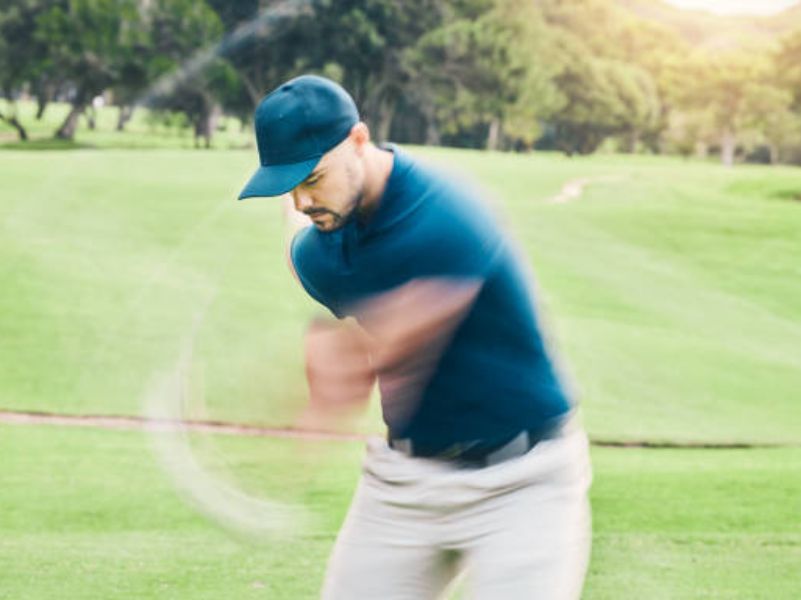
There’s a gap between knowing you need more swing speed and actually building it in a way that transfers to the course. I spent most of last year chasing that gap. I’d bought the HH Golf Swing Speed Trainer after getting tired of watching $250+ speed sticks do essentially the same thing—overspeed loading across three weight configurations. The HH stick delivered. Within a few weeks, I’d gone from 81 mph to 85 mph on TrackMan, and that alone was worth the $30.
But speed without ground force is just flailing. I noticed that while my peak velocities were climbing, my ball speed wasn’t keeping pace. Strike quality was inconsistent. I was swinging faster but not transferring that energy into the ball efficiently. That’s where the pressure plate changed everything.
By pairing the HH Golf stick with a pressure plate—I use the WhyGolf model, though any rocker-style plate works—I was able to simultaneously train neuromuscular speed and the weight shift mechanics that allow you to actually use that speed at impact. The combination is, in my experience, the single best off-season training stack a Connecticut golfer can own. Here’s the protocol I built and how to implement it yourself.
Why This Works
The HH Golf stick trains your nervous system to fire faster through overspeed principles. You swing a lighter implement to override your body’s natural governor on rotational velocity. Then you swing a heavier one to build strength at the new speed threshold. Published data from independent testing shows average gains of 4.7 mph over eight weeks with three sessions per week. The problem is that speed training in isolation tends to create disconnected movement patterns. Golfers develop faster hands and torso rotation, but their lower body doesn’t adapt in sync. The pressure plate solves this by providing instant tactile feedback on whether your weight is shifting forward at the right time. Think of it this way: the speed stick builds the engine, and the pressure plate teaches you how to put it in gear.
The 8-Week Speed and Pressure Protocol
I structured this as a progressive protocol that layers the pressure plate into your existing speed work. Weeks 1–2 focus on pure overspeed adaptation. Weeks 3–4 introduce pressure plate awareness. Weeks 5–8 integrate both tools simultaneously and push toward peak speed with optimized ground force timing. Each session takes 15–20 minutes. Three sessions per week is the minimum effective dose.
The progression from isolated speed work to integrated pressure-plate swings is intentional. If you introduce the plate too early, you’ll subconsciously throttle your speed to “get the timing right.” Build the speed ceiling first, then teach your body to use it with proper ground mechanics.
HH Stick Protocol by Week
| Week | HH Stick Work | Swings |
| 1–2 | Light weight only. 3 sets of 5 dominant-side swings. Max intent, maintain balance. | 15 |
| 3–4 | Light → Medium → Heavy sequence. 2 sets of 3 per weight. Add 5 non-dominant hand swings. | 18 |
| 5–6 | Full spectrum: L → M → H → M → L. 3 sets of 3. Add “freezer at top” drill on heavy. | 21 |
| 7–8 | Full spectrum, 4 passes. Add lead heel lift drill. Max intent every swing. | 24 + 10 |
Pressure Plate Integration by Week
| Week | Pressure Plate Work | Rest |
| 1–2 | None. Establish baseline speed numbers on TrackMan. | 90 sec |
| 3–4 | Separate session: 20 half-speed 7-iron swings on plate. Focus on hearing the tip at transition. | 60 sec |
| 5–6 | Stand on plate during light-weight stick swings. Confirm plate tips at transition every rep. | 45 sec |
| 7–8 | Full integration: all stick swings on plate. Alternate sets between stick and driver. | 60 sec |
Supporting Video Resources
SuperSpeed Golf Swing Speed — Level 1 Training Protocol
SuperSpeed Golf’s Level 1 protocol walkthrough — the same light-medium-heavy sequencing used in this HH Golf Stick program.
Athletic Motion Golf — How to Use the Ground to Generate SPEED in Your Golf Swing
Athletic Motion Golf breaks down how tour pros use ground force versus amateurs — the exact mechanic the pressure plate trains during this protocol.
Pressure Plate Setup and Mechanics
Place the WhyGolf Pressure Plate under your lead foot (left foot for right-handed golfers), arrows pointing toward the target. Position it so the pivot point sits roughly under the ball of your foot—not your heel, not your toes. This ensures the tipping action corresponds to genuine forward pressure shift, not just ankle roll. During your backswing, the plate should remain neutral or tip slightly back. At transition—the split second where your lower body starts firing toward the target while the club is still going back—the plate should audibly and physically tip forward.
I recorded my sessions on video and synced the footage with TrackMan data. On swings where the plate tipped early in transition, my ball speed jumped by 3–5 mph compared to swings where the tip was late—even though swing speed was nearly identical. That’s the efficiency the pressure plate trains.
Combining with Real Club Work and Validating Transfer
Starting in Week 5, I began hitting actual balls while standing on the pressure plate. This is where you validate that the speed gains from the HH stick are transferring. Start with 5 swings using the light-weight HH stick on the plate with no ball—pure activation swings to wake up the nervous system and confirm the plate tips at transition. Then switch to your driver or 7-iron and hit 10 balls in TrackMan’s Shot Analysis mode. Watch three numbers: swing speed, ball speed, and smash factor. If your smash factor is above 1.45 with the driver, your ground force timing is working. If it’s below 1.40, your speed gains haven’t integrated yet—go back to the plate-only drills.
Over the full 8-week protocol, swing speed gains of 3–6 mph are typical. I gained 4 mph on the stick and saw roughly 3.5 mph carry over to my actual driver. The pressure plate work improved my smash factor from 1.41 to 1.47, which translated to an additional 8–10 yards of carry even before the speed gains are factored in. Combined, I picked up about 15 yards of driver carry.
The less quantifiable benefit is tempo consistency. Speed training can make your swing feel jerky and rushed if you’re not anchoring it with proper sequencing. The pressure plate prevents this by giving your body a physical checkpoint every single rep. After Week 6, my transition felt noticeably smoother, and my miss pattern tightened.
Key Metrics to Track Throughout the Protocol
- Swing speed (TrackMan or app): expect +3–6 mph over 8 weeks
- Ball speed: should rise proportionally; if it lags, ground force timing is off
- Smash factor: target 1.45+ with driver; the pressure plate’s primary contribution
- Carry distance: the final proof — expect +12–18 yards combined
- Plate tip timing: should occur at transition, not early backswing or late downswing
Final Word
The HH Golf Swing Speed Trainer runs about $30–$35 on Amazon. The WhyGolf Pressure Plate is $99. Total investment: roughly $130. For comparison, a SuperSpeed system alone is $199–$299, and a force plate system like BodiTrak or Swing Catalyst runs $1,000+. If you already have simulator access, this is the highest-ROI training aid combination I’ve found.
Speed training without ground force awareness is incomplete. The HH Golf Stick will make you faster, and the numbers will prove it. But if you’re not simultaneously teaching your body where to put that speed—into the ball through proper weight shift and sequencing—you’ll leave yards on the table. The pressure plate closes that loop. It turns a $30 speed stick into a legitimate performance system.
I’ve run through this protocol twice now, once in late fall and once over the winter. Both times, the gains carried into my first rounds of the spring season. That’s the test that matters—not whether you can swing a weighted stick 5 mph faster in a simulator bay, but whether you can hit it 15 yards past your old mark on Hole 1 when it counts. For me, the answer has been yes. I suspect it will be for you too.
David is an avid golfer who loves walking Connecticut’s courses and playing alongside his family. He’s passionate about golf course architecture and one day hopes to play at Pebble Beach.