
One of the most common swing faults among amateur golfers is swaying, lateral movement away from the target during the backswing. It feels like you’re making a big turn and loading up for power, but in reality, you’re destroying the foundation of a consistent golf swing. The result is inconsistent contact, loss of distance, and a low point that moves around from shot to shot. You might hit one pure, then fat, then thin, with no clear explanation for why.
The problem is that most golfers don’t realize they’re swaying. It feels like rotation because your upper body is turning. But your lower body is sliding, not rotating. The difference between a proper hip turn and a sway is subtle when you’re making the swing, but obvious when you see it on video or in a mirror. Once you understand the distinction and learn to feel the correct movement, ball striking consistency improves immediately.
This article breaks down the difference between hip rotation and sway, explains why sway kills your swing, and provides three simple drills you can use at home or on the range to eliminate lateral movement and build a stable, powerful turn.
Hip Turn vs Sway: What’s the Difference?

Proper Hip Turn: Rotation Around a Stable Axis
A proper hip turn is rotational, not lateral. Your hips rotate around a relatively fixed center—specifically, around your trail hip (right hip for right-handed golfers). During the backswing, the trail hip rotates back and slightly deepens (moves behind you), while the lead hip rotates forward. Your spine angle stays constant, and your head position remains stable over the ball. Crucially, your center of mass does not shift significantly to the right. Weight transfers to your trail foot through pressure shift, not through lateral slide.
Think of it like a door hinge. The hinge is your trail hip, and the door (your pelvis) rotates around that fixed point. The door doesn’t slide sideways—it pivots. This is what proper hip rotation looks like.
Sway: Lateral Movement Off the Ball
Sway is when your entire lower body slides laterally away from the target during the backswing. Instead of rotating around your trail hip, your hips shift to the right (for right-handed golfers). Your head moves off the ball, your spine angle changes, and your center of mass drifts outside your trail foot. This is a translation, not a rotation. You’re sliding, not turning.
Sway often feels powerful because you’re making a big move and loading weight onto your trail side. But it’s a false sense of power. You’ve moved away from the ball, which means you now have to slide back toward it on the downswing to make contact. This requires perfect timing and creates massive inconsistency in where the club bottoms out.
Hip Turn vs Sway: Quick Comparison
| Characteristic | Proper Hip Turn | Sway |
| Movement type | Rotation around trail hip | Lateral slide away from target |
| Head position | Stays over the ball | Moves laterally off the ball |
| Center of mass | Stays centered | Shifts outside trail foot |
| Spine angle | Remains constant | Changes (stands up) |
| Result | Consistent contact, stable low point | Inconsistent contact, variable low point |
Why Sway Destroys Your Golf Swing
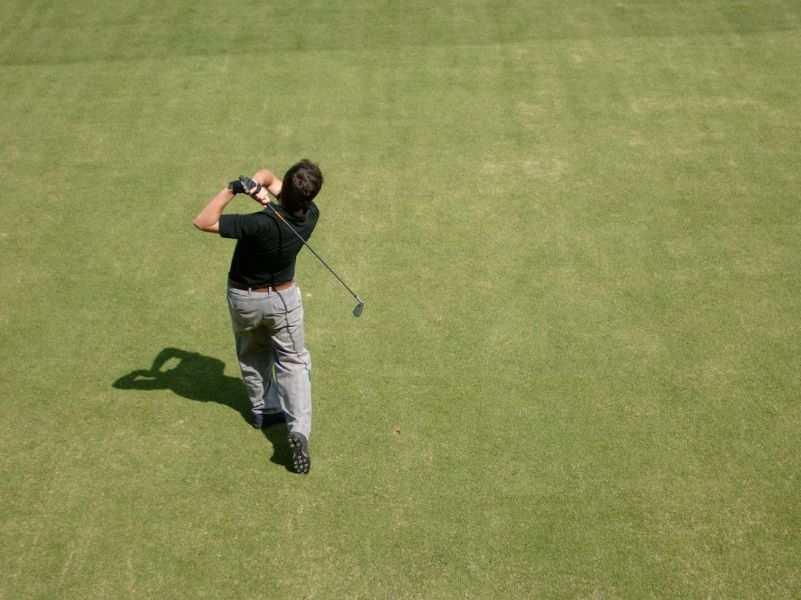
Inconsistent Low Point
The low point of your swing is where the clubhead reaches its lowest point in the arc. For solid iron contact, this needs to be a few inches in front of the ball (after impact). When you sway, your low point moves. If you sway right on the backswing, you have to slide back left on the downswing to return the club to the ball. If you slide too much or too little, the low point shifts. Sometimes you hit behind the ball (fat), sometimes you hit the top half (thin), and occasionally you time it perfectly and hit it pure. But there’s no consistency because the movement is too variable.
Loss of Power
Power in the golf swing comes from rotation, not translation. When you rotate your hips and torso against a stable base, you create torque—stored energy that releases explosively through impact. When you sway, you dissipate that energy into lateral movement. You’re not coiling; you’re sliding. On the downswing, instead of unwinding rotational force into the ball, you’re trying to shift your weight back and time the club’s return. This is mechanically inefficient and produces weak contact.
Poor Contact and Misses
Sway causes multiple contact issues. The most common is the ‘reverse pivot’ on the downswing, where you shift weight onto your trail foot through impact (the opposite of what should happen). This leads to blocks, pushes, and weak contact. Even when you manage to shift forward, the timing window is so small that your misses are large. Fat shots, thin shots, and topped balls are all symptoms of excessive lateral movement during the swing.
Supporting Video Resources
Fix Your Sway & Backswing Rotation FAST! (Make a Tour Level Pivot)
This Hip Habit is Keeping You From a Consistent Swing
Three Drills to Eliminate Sway and Build Proper Hip Turn
Drill 1: The Chair Drill
This drill gives you an external reference point that prevents lateral movement.
Setup: Place a folding chair or similar object just outside your trail hip at address. The chair should be close enough that if you sway during the backswing, your hip will make contact with it.
Execution:
- Step 1: Take your normal golf setup with a club.
- Step 2: Make a slow backswing, focusing on rotating your trail hip back without letting it touch the chair.
- Step 3: If your hip bumps the chair, you’re swaying. If you can complete the backswing without contact, you’re rotating properly.
- Step 4: Repeat 10-15 times, gradually increasing speed until you can make a full-speed backswing without touching the chair.
What you’re feeling for: Your trail hip should feel like it’s rotating back and slightly deepening (moving behind you), but not sliding laterally away from the target. The chair provides instant feedback if you hit it, you’re swaying.
Drill 2: The Wall Drill
This drill is similar to the chair drill but uses a wall as a reference, which is useful if you practice indoors or want a more permanent setup.
Setup: Stand with your trail side about 6-8 inches from a wall. Take your normal golf address position.

Execution:
- Step 1: Make a backswing. If you sway, your trail hip or shoulder will hit the wall.
- Step 2: Focus on rotating around your trail hip without letting any part of your body touch the wall.
- Step 3: Once you can complete a backswing without touching the wall, move slightly closer (4-6 inches away) and repeat.
- Step 4: The closer you get to the wall without touching it, the more precise your rotation becomes.
What you’re feeling for: The same sensation as the chair drill, rotational movement around a fixed axis, not lateral slide. Your trail hip should feel like it’s rotating into depth (behind you) rather than sliding away from the target.
Drill 3: The Feet-Together Drill
This drill removes your ability to sway by eliminating your base of support, forcing you to rotate.
Setup: Place your feet together (heels touching or nearly touching). Hold a club and take your normal grip.
Execution:
- Step 1: Make a slow backswing. With your feet together, any attempt to sway will cause you to lose balance.
- Step 2: You’ll be forced to rotate your hips and torso around your center to maintain balance.
- Step 3: Make 10-15 slow swings without losing balance. Then progress to hitting balls with a 7-iron or wedge.
- Step 4: Hit 10-15 balls with your feet together, focusing on maintaining balance and rotating (not swaying).
What you’re feeling for: Balance and rotation. If you sway even slightly, you’ll lose your balance and fall to the side. This drill teaches you what pure rotation feels like because swaying is physically impossible when your feet are together.
Final Word
Eliminating sway is one of the fastest ways to improve ball striking consistency. The difference between rotating and sliding is small in terms of movement, but enormous in terms of results. Proper hip rotation creates a stable foundation for the swing, a consistent low point, and efficient power transfer. Sway destroys all of that.
The three drills in this article, the chair drill, wall drill, and feet-together drill, provide immediate feedback that makes the correction obvious. You don’t need a coach watching you or a launch monitor analyzing your swing. The chair or wall will tell you if you’re swaying, and the feet-together drill will force you to rotate correctly. Use these drills at home in front of a mirror, or on the range before hitting balls.
Start with the chair drill. Do 15-20 backswings without touching the chair. Then progress to slow-motion full swings, then hitting balls. Track your contact quality. If you’ve been struggling with fat and thin shots, you should see immediate improvement in consistency once you eliminate lateral movement. For more on building proper movement patterns through deliberate practice, see our article on shallowing the club in the golf swing.
Film yourself from the face-on angle and compare before-and-after footage. The visual difference will be striking, and your ball contact will confirm it. Proper hip turn isn’t just a technical detail, it’s the foundation of consistent, powerful ball striking. Once you’ve locked in those mechanics on camera, you can combine that power with perfect rhythm by learning how to use Tour Tempo ratios to optimize your driver swing on Trackman.

David is an avid golfer who loves walking Connecticut’s courses and playing alongside his family. He’s passionate about golf course architecture and one day hopes to play at Pebble Beach.