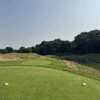
Tunxis Country Club – Green Course is a public par-70 course measuring approximately 6,446 yards from the tips. The course was originally designed in 1962 by Al Zikorus and is located in Farmington, Connecticut.
The Green Course at Tunxis has undergone a significant evolution since its debut, particularly during the 1990s when Mike Zikorus, son of original architect Al Zikorus, added nine new holes to the layout. This renovation split the original eighteen holes, with nine becoming the standalone Red Course along the Farmington River while nine holes were retained and combined with the new construction to form the current Green Course. The resulting parkland-links hybrid occupies an estimated 100 to 120 acres of rolling terrain that feels surprisingly removed from Farmington’s suburban character, offering a rural sense of isolation enhanced by mature tree stands and strategic mounding. The routing presents a fascinating dichotomy between an open front nine with wide corridors and a tighter, more wooded back nine running from the 13th through 16th holes, though recent tree clearing near the first hole has created greater continuity across the layout. The design philosophy leans toward strategic rather than penal golf, with water hazards positioned to threaten rather than dominate, generous bailout areas, and multiple angles of approach that reward thoughtful course management. The player who thrives here appreciates cerebral shotmaking over pure power, enjoys working the ball both directions off the tee, and values green complexes that demand precision without feeling contrived. The slope rating of 129 from the blue tees indicates this layout requires more than raw distance to score well, as the mounding, fairway bunkers, and undulating putting surfaces create challenges that favor the player who thinks two shots ahead.
Strategic Test
| Handicap | Course Strategy |
|---|---|
| High Handicap (18+) | From the red tees at 5,327 yards with a slope of 121 and rating of 68.4 for women, higher handicappers will find the Green Course offers playability without sacrificing interest. The white tees at 6,036 yards provide a comfortable challenge for men in this range, with a 127 slope and 68.7 rating translating to roughly 15 to 20 strokes over par for most players. The 15th hole exemplifies the ideal test for this demographic, playing 325 yards from the blues as a short par-4 that rewards accuracy over ambition. A driver or fairway wood down the middle leaves a short iron or wedge approach to a green fronted by water, creating a risk-reward scenario where the conservative tee shot with a hybrid or long iron eliminates danger and still leaves a makeable score. The generous width on most holes accommodates the occasional errant tee ball, and the mounding provides visual guidance rather than severe punishment. |
| Mid Handicap (8-18) | Mid-handicappers should consider the white tees at 6,036 yards or the gold tees at 5,362 yards, depending on whether they’re trending toward single digits or still building consistency. The 127 slope from the whites will add approximately 8 to 14 strokes to par for most in this category, while the gold tees at 121 slope and 67.0 rating create a more manageable scoring environment. The 17th hole provides the ideal examination for this skill level, measuring 531 yards from the blues as a par-5 that opens up possibilities for those who can hit two quality shots. The hole plays relatively open with minimal trouble fronting the green, making it reachable in two for longer hitters while still offering a strategic three-shot approach for those playing conservatively. Club selection off the tee determines whether the second shot can attack or must lay up, and the ability to shape shots around the course’s natural contours becomes increasingly valuable as handicaps drop through this range. |
| Low Handicap (0-8) | Accomplished players will want the blue tees at 6,446 yards, where the 129 slope and 70.3 rating create a proper championship test that should yield scores in the low-to-mid 70s for scratch golfers. The demanding par-3 5th hole at 205 yards serves as one of the layout’s signature challenges, requiring a long iron or hybrid to a well-protected green complex where distance control proves critical. Missing the putting surface leaves difficult up-and-downs, and the green’s contours punish approaches that fail to match pin position with proper trajectory. The course rewards players who can work the ball both ways, particularly on holes like the 2nd and 4th where draws set up better angles, and the 5th and 6th where fades provide optimal positioning. Low handicappers will appreciate how the 13th through 16th hole stretch demands both power and precision through tighter corridors, and how the slope rating accurately reflects a course that favors thoughtful strategy over aerial assault. |
Nearby Course Alternatives
Gillette Ridge Golf Club in Bloomfield sits approximately 15 minutes northwest of Tunxis and represents an entirely different architectural philosophy. Arnold Palmer and Ed Seay designed this 7,191-yard par-72 test that opened in 2004 on approximately 200 acres of dramatically rolling terrain. From the black tees, the slope rating reaches a formidable 141 with a 75.4 course rating, establishing Gillette Ridge as one of Connecticut’s more demanding public layouts. The course features significant elevation changes that Tunxis lacks, with several holes requiring substantial carries over wetlands and forced carries that eliminate the ground game options available at the Green Course. The design emphasizes target golf with tree-lined corridors, strategic lake placements, and greens that demand precise approach work rather than the run-up options Tunxis provides. The conditioning typically runs a notch above most municipal facilities, with bentgrass fairways and greens maintained to stimulate faster surfaces. Players who gravitate toward modern American golf architecture and enjoy elevated tee boxes with expansive views will find Gillette Ridge provides more visual drama and length-dependent challenges compared to Tunxis’s subtler strategic puzzles. The aggressive slope ratings mean higher handicappers should seriously consider playing forward tees, making this better suited for low-to-mid handicappers who appreciate courses that demand both distance and accuracy off the tee.
Stanley Golf Course in New Britain offers a completely different experience just 15 minutes east of Tunxis, presenting 27 holes of classic parkland golf on a compact municipal property. The facility features three nine-hole courses designed by Robert J. Ross and Geoffrey Cornish, with various 18-hole combinations ranging from 6,378 to 6,443 yards with slopes between 111 and 124. The Red and White nines opened in 1930, while the Blue nine came along in 1955, creating a layout with genuine Golden Age bones that contrast with Tunxis’s more contemporary routing patterns. The course occupies flatter terrain with less dramatic mounding, relying instead on mature tree placement, strategic bunkering, and modest greens to create interest. The slope ratings in the low-to-mid 120s indicate a more forgiving test than either Tunxis Green or Gillette Ridge, making Stanley particularly attractive to mid-to-high handicappers seeking a walkable course with historical character. The facility maintains solid conditioning for a municipal operation and offers genuine variety through its 27-hole configuration, allowing regulars to mix up their routing. Players who value classic design principles, prefer walking to riding, appreciate shorter yardages that emphasize accuracy over power, and enjoy the accessibility and straightforward nature of traditional municipal golf will find Stanley provides excellent variety in their regular rotation alongside Tunxis’s more strategic demands.
Final Word
Beyond the golf itself, Tunxis Country Club provides a comprehensive practice facility with a driving range featuring mat stations that allow year-round practice opportunities when weather and daylight permit. The putting greens offer ample space for pre-round preparation, and the short game area gives players the opportunity to work on pitch shots and bunker play. The facility houses a well-stocked pro shop with current equipment and apparel options, ensuring players can address any equipment needs before their rounds. The clubhouse anchors the property with the renovated Tunxis Tavern serving breakfast, lunch, and dinner with a full menu that elevates the dining experience beyond typical turn shack fare. An elegant ballroom with old-world architectural details accommodates weddings and corporate events, while the impressive indoor-outdoor Pavilion provides space for up to 300 guests among towering pines for larger gatherings. Two snack bars positioned on the property keep players fueled during their rounds without requiring a return to the main clubhouse. The 45-hole complex operates as a true golf destination rather than merely a place to play eighteen holes, with the variety between the Green, White, and Red courses giving regular players legitimate reason to return frequently. What distinguishes the Green Course specifically within the Tunxis portfolio is its balance between accessibility and strategic depth, occupying a middle ground where thoughtful architecture rewards course management without punishing recreational players who simply want an enjoyable afternoon. The course has remained relevant for over six decades precisely because it never mistakes difficulty for quality, instead offering a thinking person’s layout where strategic choices matter more than raw power, and where multiple tee options ensure everyone from beginners to accomplished players can find an appropriate challenge that matches their current skill level while maintaining architectural integrity.

David is an avid golfer who loves walking Connecticut’s courses and playing alongside his family. He’s passionate about golf course architecture and one day hopes to play at Pebble Beach.