
The Orchards Golf Course is a public par-32 course measuring approximately 1,625 yards from the white tees. The course was originally designed in 1997 by John R. Casey Sr. and is located in Milford, Connecticut.
Occupying what feels like fewer than 25 acres, The Orchards is a compact course routed through flat suburban land. The terrain is uniformly level, and the routing style relies heavily on abrupt doglegs and proximity between greens and tees. The design vibe is utilitarian—with minimal shaping or contouring—but there are hints of thoughtful green complexes and basic strategic intent. Players who enjoy short loops, working on wedges, or introducing juniors to the game will find plenty to like. Those seeking architectural sophistication or spatial variety will likely be disappointed.
Walkability
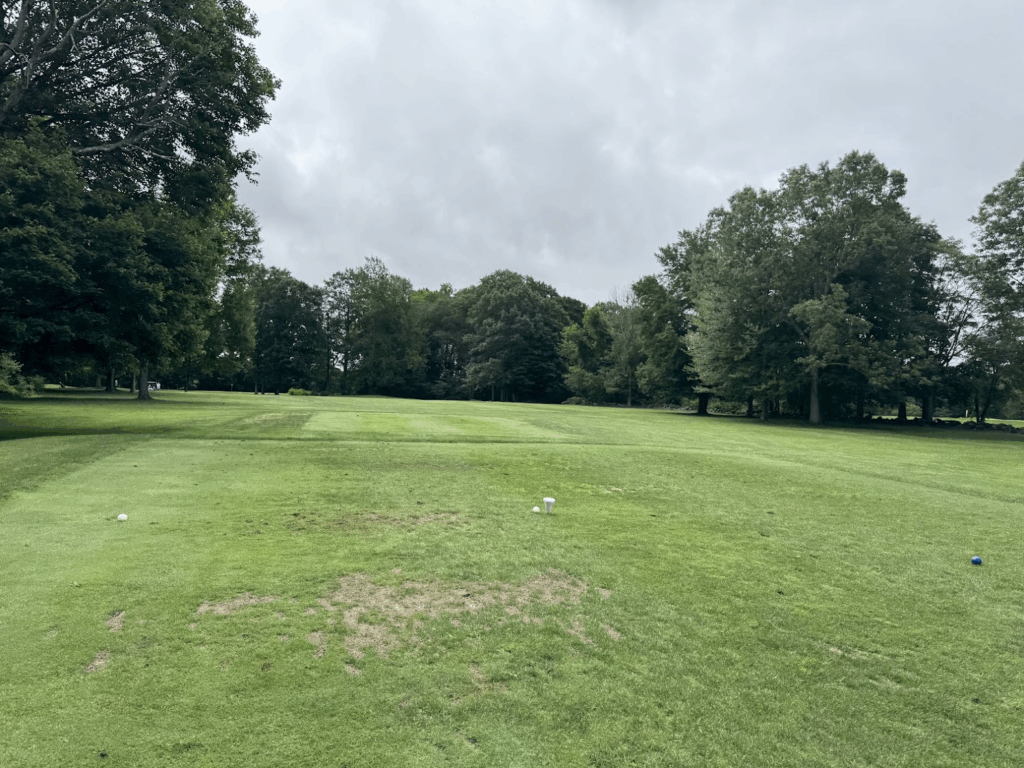
Walkability is one of The Orchards’ strongest assets. With no elevation change across the entire property and yardages that rarely exceed 220, it’s a supremely comfortable course to walk. Green-to-tee transitions are immediate, and the total loop flows in tight sequence—ideal for beginners, kids, or twilight solo rounds.
- Pro: The entire routing is under 1,700 yards, which makes for a breezy 75-minute loop even with a pushcart. Holes 6, 7, 8, and 9 form a compact internal square that makes the finish particularly fluid and efficient to navigate.
- Con + Fix: Routing confusion mars the opening tee shot. From the 1st tee, the green for Hole 2 appears directly ahead, creating a misleading visual that caused my group to delay for several minutes. The actual green for Hole 1 is hidden sharply to the left, behind a blind dogleg. To improve orientation and visual clarity, the club should plant a screen of arborvitae or tall pines between tee box 1 and green 2. Several of the sharp, acute-angle doglegs—notably Holes 1 and 5—require circuitous tee-to-green transitions that break the flow and disorient first-time players.
Strategic Test
Strategic interest at The Orchards is limited by its compressed footprint, but flashes of intentionality appear—especially around the green complexes of Holes 6 and 7. These holes ask players to select specific trajectories and manage distance precisely. However, most tee shots lack options or depth.
- Pro: Hole 7 (167 yards) is the standout. This par 3 plays slightly uphill and into a modestly elevated green that’s flanked by thick rough on both sides and slopes from back to front. It calls for a precise mid-iron shot that lands soft, particularly if the pin is on the back shelf. A player hitting a high draw will be rewarded, as the right-to-left shot shape helps hold the putting surface. A fade can work too, but needs to carry all the way to avoid rolling off the right collar. A front pin brings the short miss into play, but leaves a delicate uphill chip with little margin for spin misjudgment. There’s no room for bailout long or right, and even a safe center-of-green play can leave a tricky two-putt from 40 feet if the pin is tucked. What elevates the hole is how many decisions hinge on wind, shot shape, and landing trajectory. If you underclub and spin it too much, you’re short. If you get aggressive and go long, you’re dead. It forces you to pick a number, a shape, and a miss zone—all from a flat lie. On a course with so few true decision-making moments, this is one of the rare places where better players will pause and think.
- Con + Fix: Hole 2 offers no such tension. At 93 yards with 79 to the front, the shot is a simple flick wedge into a flat green with no bunkers or meaningful contours. The hole could be dramatically improved by repositioning the green slightly back and left, introducing a front-left bunker and narrowing the collar to force better contact and directional control.
Playability
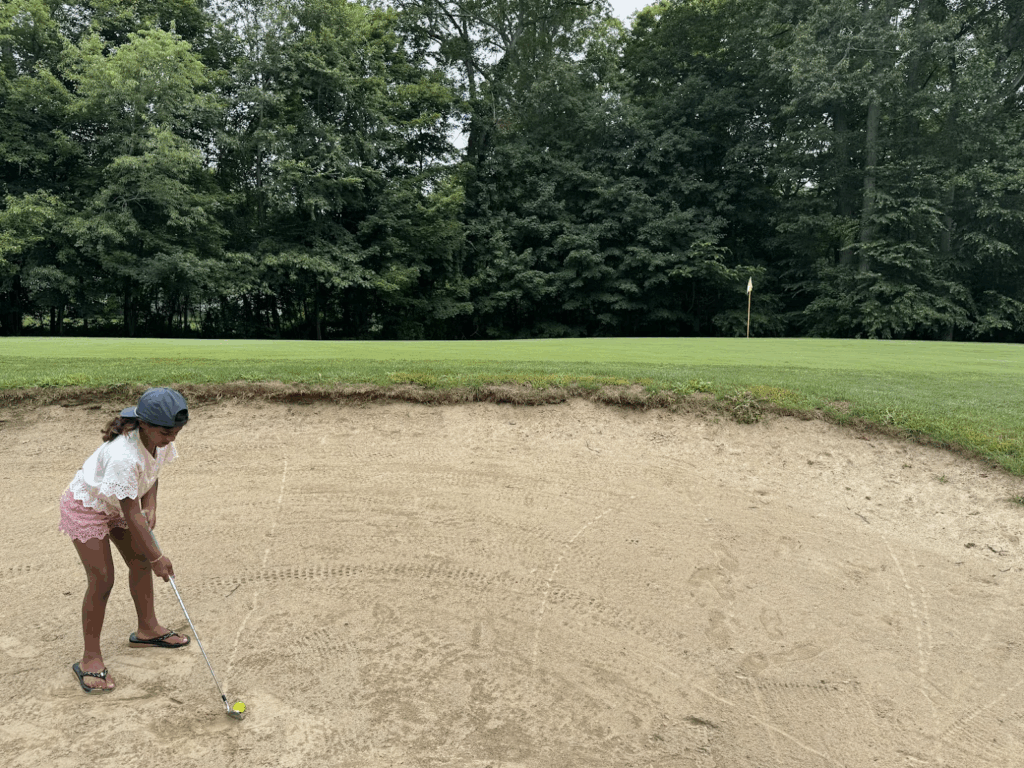
The Orchards excels in accessibility for newer players. High handicappers won’t lose balls here, and the short yardages make it possible to play with just a handful of clubs. Tee boxes are flat, and greens are receptive, encouraging positive early experiences in the game.
- Pro: Hole 6 is a model of fair challenge. At 120 yards, it’s short enough for all players but introduces a deep cross-bunker that frames the green beautifully. The back-to-front slope allows low shots to run on, while high balls can hold their landing spot. It’s honest and rewarding.
- Con + Fix: Hole 5 is arguably the worst offender on the course. At 217 yards, it features a disorienting dogleg left that turns almost 90 degrees. Most players lay up blindly to the corner, then pitch over a bunker to a raised green. The angle is so sharp that poor tee shots can veer into neighboring holes. This should be rebuilt as a 135-yard par 3 with the existing green and a new teeing corridor.

Atmosphere
The Orchards has a welcoming, low-key ambiance typical of well-loved municipal courses. There’s a strong community element, and efforts to include junior programming and family-friendly features are evident. While the natural setting is limited, the course retains a humble charm.

- Pro: The presence of a robust kids’ program, a surprisingly large practice green, and courteous staff contribute to a positive environment. It’s clearly designed to bring more people into the game without intimidation.
- Con + Fix: Visually, many holes blend together with few standout vistas or landscape features. The 9th attempts to close strong with a corridor framed by tall trees, but it feels more like a tight alley than a signature moment. Introducing native plantings, ornamental grasses, or small-scale water features near Holes 3 and 9 would add needed character.
Final Word
I came to The Orchards with modest expectations and left with mixed feelings. On one hand, it’s a perfectly functional course for what it’s trying to be—a space where juniors and beginners can learn the game. On that front, it succeeds. The conditions are solid, the greens roll true, and the staff is welcoming. But from an architectural and routing standpoint, it’s a deeply flawed design. Holes 1 and 5, in particular, need reimagining if the course ever wants to appeal to more serious players.
The layout tries to force too much program into too little acreage. Several tee-to-green transitions—especially the sharp angular ones—create unnecessary confusion for first-time players and limit any natural rhythm to the round.
When compared to nearby 9-holers like Carl Dickman in Fairfield, which leans more into strategic variety with a more spacious routing and stronger hole identity, or Tashua Glen in Trumbull, which manages to inject elevation changes and thoughtful angles into a compact footprint, The Orchards feels constrained and overly forced. Yet, there’s a place for it—a course with community value and a low barrier to entry. If I were tasked with renovating it, I’d lean into its par-3 identity, eliminate the weak doglegs, and let the greens shine. There’s a good course in here—it’s just hiding in plain sight.

David is an avid golfer who loves walking Connecticut’s courses and playing alongside his family. He’s passionate about golf course architecture and one day hopes to play at Pebble Beach.