

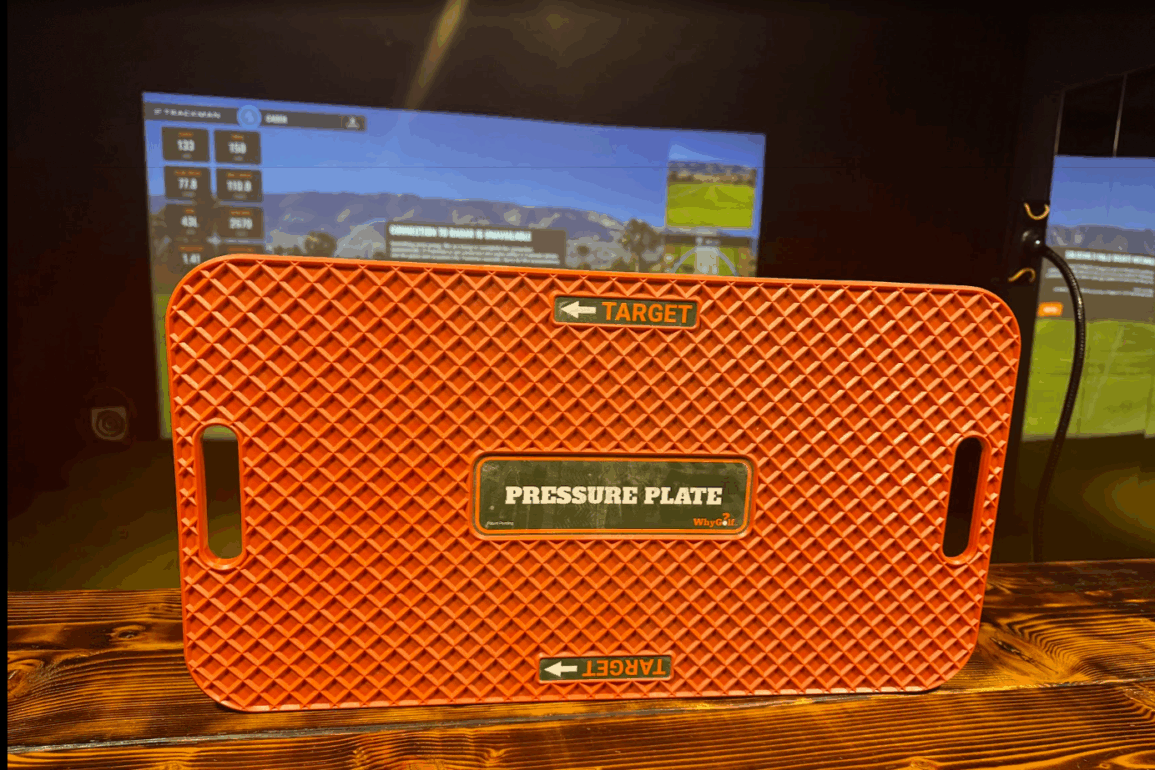
The WhyGolf Pressure Plate is a simple, sturdy training aid that gives golfers immediate feedback on weight shift during the swing. Shaped like a see-saw, it rocks forward when pressure is applied to the lead foot — helping golfers learn to post properly into impact. It’s low-tech, portable, and easy to use, especially when paired with launch monitors like TrackMan to evaluate its impact on metrics like launch angle, spin loft, and carry distance. However, at $99, it’s a premium price for a passive tool — read on to see whether it’s worth it for your game.
Efficacy
The Pressure Plate is highly effective at training ground force mechanics through feel. By physically tipping when the user shifts weight forward, it reinforces a proper transition and finish position. This can help reduce early extension, scooping, or reverse pivots. When used regularly, it builds better low-point control and compression.
It excels in training sequencing and awareness but doesn’t address swing plane, face control, or path. Think of it as a targeted feel trainer for pressure — not a comprehensive solution.
Here’s the condensed sequence to follow during a swing:
- Address Setup: Place the Pressure Plate under your left foot (for right-handed golfers), with the arrows pointing toward the target. Stand square, balanced, and athletic.
- Backswing: Keep your weight centered and avoid drifting over your trail foot. Maintain coil and stability.
- Transition: Shift your weight into your lead foot as the downswing begins. The Pressure Plate should audibly and physically tip forward at this exact moment.
- Impact: Your weight should be mostly on your lead foot (around 80%). You should feel braced and posted through impact with hands leading the clubface.
- Finish: Maintain balance with all weight on the front side. The Pressure Plate should stay fully tipped forward.
This sequence helps reinforce the feel of proper ground engagement — critical for low-point control, compression, and repeatable ball-first contact.
Ease of Use
Setup is instant: place it under your lead foot, and you’re ready to go. No batteries, no calibration, and no learning curve. It’s light enough to carry in a golf bag, works indoors and out, and can be used with or without hitting balls.
Its stability is a major plus. Unlike wobbly balance discs or DIY contraptions, the WhyGolf model is solid underfoot. Players can confidently make full swings without slipping, which makes it ideal for sustained use over time.
Measurability
The Pressure Plate doesn’t collect data itself, but it integrates well into a measurable routine when paired with TrackMan Shot Analysis mode. Users can monitor key metrics like attack angle, spin loft, ball speed, launch angle, spin rate, height, and carry distance. Here’s what happens if one doesn’t weight shift properly (as trained by the pressure plate).
| Metric | Effect of Poor Weight Shift |
|---|---|
| Attack Angle | Without proper pressure into the lead foot, the attack angle becomes too shallow. The club may skim the ground or bottom out behind the ball, increasing the risk of fat and thin shots. Ground-first contact becomes inconsistent, especially with irons. |
| Spin Loft | Poor weight shift limits forward shaft lean and maintains excessive dynamic loft, which widens spin loft. This results in weak, high-spinning shots with poor compression and inefficient energy transfer to the ball. |
| Ball Speed | Inadequate lower-body movement reduces the ability to transfer energy from the ground up. This typically leads to lower ball speed, even if clubhead speed remains the same, because strikes tend to be off-center and poorly compressed. |
| Launch Angle | Players who hang back often present more loft at impact, increasing launch angle. This causes high, floaty ball flights that climb too quickly and stall in the air, reducing overall distance and control. |
| Spin Rate | A lack of pressure shift often leads to less precise contact, which can either decrease spin (from low compression) or create excess spin from glancing, high-loft strikes. In either case, spin becomes inconsistent and hard to control. |
| Height | Poor weight transfer leads to higher dynamic loft and spin, resulting in ballooning shots. Peak height increases beyond ideal levels, especially with mid-irons, making shots vulnerable to wind and reducing distance. |
| Carry Distance | Failure to shift pressure forward reduces both compression and ball speed. As a result, carry distance suffers significantly, even with solid tempo. The ball launches high but weak, often falling well short of target yardages. |
Cost
At $99, the WhyGolf Pressure Plate is priced near the top of the no-tech golf training aid market. While its durable construction and golf-specific feedback are strong points, the price is difficult to justify for most recreational players — especially when it offers no built-in data, has no adjustability, and relies entirely on feel.
Comparable results can often be achieved using lower-cost tools. A $19 AmazonBasics Wobble Balance Board provides instability that builds lower-body control and awareness. Even more specific to the Pressure Plate’s intent are rocker boards. These also mimic forward-tipping action and can also simulate the sensation of weight transfer into the front side during transition, helping train the same lead-side posting pattern promoted by the WhyGolf model. What separates the Pressure Plate is its refined feel, consistent resistance, and golf-specific footprint. But those refinements come at a high markup. For many players, especially those not practicing with a launch monitor or working under a coach, these extras may not be worth the added cost.
Final Take
Despite offering clear feedback and measurable improvement when combined with structured launch monitor use, the WhyGolf Pressure Plate is ultimately difficult to recommend for most golfers. At $99, it lacks adjustability, built-in data tracking, and broader swing diagnostic utility. For casual players or those on a budget, lower-cost options like balance discs or wobble boards provide much of the same benefit at a fraction of the cost. Unless you’re a coach or dedicated data-driven player, this tool may not deliver enough return on investment.

David is an avid golfer who loves walking Connecticut’s courses and playing alongside his family. He’s passionate about golf course architecture and one day hopes to play at Pebble Beach.







Can’t believe this device is on sale at 99 down from 130. Ridiculous and this is why I think golf gadgets need to be reigned in. Someone post a 3D print STL of this. Would pay maybe 30 for this max.