Golf Course Design by Robert Muir Graves and Geoffrey Cornish is a comprehensive, 445-page reference that explores nearly every facet of building and understanding a golf course. Graves and Cornish, both accomplished golf architects, bring decades of hands-on experience to this work. Graves, who was known for his work in California and the Pacific Northwest, adds West Coast innovation and a builder’s mindset, while Cornish complements with a grounded, research-based approach rooted in New England tradition. Together, they walk readers through routing logic, grading plans, turf selection, irrigation strategy, construction equipment, permitting challenges, and even the financial realities of golf development. The book is methodical and deep—essentially a textbook—and even includes practical exercises for aspiring designers.
Cornish’s influence is particularly strong in Connecticut, with designs and renovations at Lyman Orchards, Oxford Greens, and contributions to TPC River Highlands, among many others. His emphasis on walkability, land efficiency, and subtle strategy shows up in dozens of courses across the region. Reading this book helped me understand those design philosophies in action. It’s an eye-opener for anyone who wants to understand not just how a course looks, but how and why it works. For Connecticut golfers, it’s a guide to recognizing the architectural DNA of the places we play every week.
Content
Graves and Cornish cover everything from routing fundamentals to grading, turfgrass evapotranspiration rates, financing, and even architectural training. The writing balances engineering know-how with conceptual elegance, especially when discussing shot values, elevation change, and land exchange logistics. They manage to walk the line between academic and practical, offering ideas you can apply whether you’re designing a course or just trying to understand why certain holes play better than others.
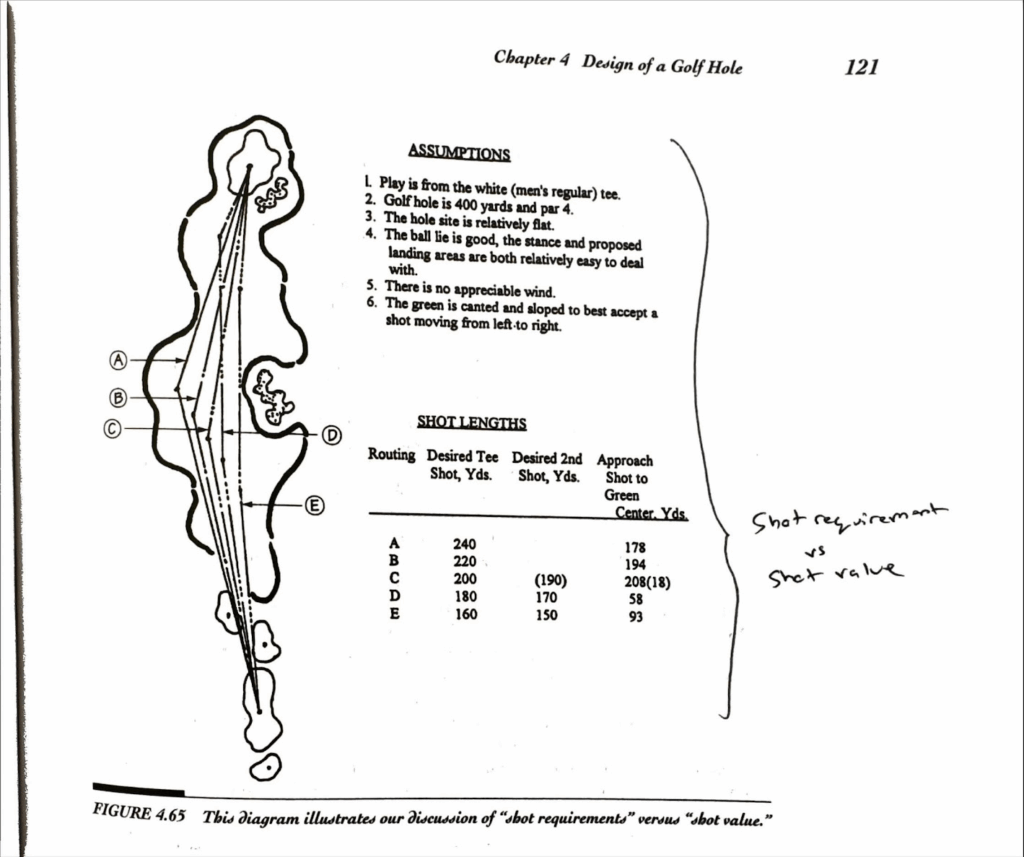
Pro: The section on designing individual golf holes (Chapter 4) blew my mind. Their shot-length table (Figure 4.65) maps out multiple routings for the same 400-yard hole with different tee shots, second shots, and approach angles. It changed how I approached hole 7 at my home course, where I started playing a low runner off the tee to the left side to open up the green angle—something I never would’ve thought about before. That chart, more than any other single diagram, made me think about decision-making in layers. What felt like a forgettable hole was suddenly full of possibilities.
Con: The book is entirely architecture-focused. If you’re looking for any swing tips or short game instruction, look elsewhere. It also leans heavily on design theory without always grounding it in real-world case studies for casual readers. While I loved the depth, I could see how a newer golfer might get lost without more applied examples or before-and-after transformations.


Structure
The book is divided into three logical parts: “The Game and the Course,” “Construction and Grow-In,” and “The Business of Golf Course Design.” It progresses naturally from theory to practice, though it’s thick enough to double as a reference manual. Chapters can stand alone, which makes revisiting key ideas easy. It doesn’t spoon-feed, but it rewards curiosity—especially if you’re willing to follow cross-references and bounce between chapters like a real-world routing plan.
Pro: I appreciated how each chapter builds on the last without becoming redundant. The transition from routing theory to grading and then into turf and irrigation felt like walking the land step-by-step as a real architect would. By the time I reached the back third, I was seeing connections I missed on the first read. It’s one of those books that quietly assumes the reader is smart enough to keep up, and I liked that.
Con: Some chapters, especially those with multi-author contributions, lose a bit of cohesion. There are few subheadings within long chapters, which makes skimming difficult if you’re trying to re-find a specific insight. I wish there were clearer summary sections at the end of major topics, especially in the technical chapters like turfgrass science.


Visuals
The visuals are utilitarian but powerful. Diagrams like the starburst routing concept (Figure 2.43) or the turfgrass evapotranspiration table (Table 13.7) do far more than decorate—they explain. Hole sketches, routing plans, drainage schematics, and even lake-liner construction diagrams are sprinkled throughout. These illustrations don’t try to impress—they try to teach. And they succeed.
Pro: One standout was the land swap map for Minisceongo Golf Club (Figure 16.3). It helped me understand how geography, politics, and design all collide to make a feasible routing. I’ve looked at local GIS maps completely differently ever since. Similarly, the lake lining detail (Figure 8.16) now lives rent-free in my head whenever I play Whitney Farms, and I catch myself scanning for telltale signs of clay banks or buried liners.

Con: I wish there were more 3D elevation sketches, especially when discussing green contouring or bunker shaping. Without them, some vertical concepts feel abstract. A side-by-side of green profiles or before/after shaping shots would have made a few sections—especially grading and drainage—much more vivid.
Engagement
This isn’t beach reading, but it’s not dry either. The tone is practical, knowledgeable, and seasoned. You can feel the authors’ years in the field, especially Cornish, who helped shape much of New England’s golf landscape. It rewards slow, thoughtful reading more than quick skimming. That said, this is absolutely a heavy read—essentially a textbook, and it even includes design exercises. It’s the kind of book you digest in small doses with a pencil in hand.
Pro: I stayed hooked because every chapter gave me something concrete to apply on my next round. The explanations are clear without being dumbed down. It feels like you’re being coached by someone who’s walked more ground than you ever will. And as someone who plays both new and old tracks across Connecticut, I now have a richer vocabulary for what I’m seeing and feeling out there.
Con: Some segments on permitting and legalities (especially in Part III) are dense and bureaucratic, best skimmed unless you’re planning to actually build a course. Still, I found it oddly fascinating—and slightly daunting—to see the exhaustive list of permits and environmental considerations that go into even a modest course renovation. It gave me a new respect for what had to happen to make a place like Bandon Dunes possible. Honestly, it makes the green fee easier to stomach when you realize what went on behind the scenes just to get it built.
Final Thoughts
Golf Course Design by Graves and Cornish fundamentally changed how I play, watch, and think about golf. I now walk every course with a mental checklist: where are the angles, where is the contour helping or hurting, what is the tee shot really asking me to do? Even televised golf looks different—I notice land movement and pin placements with far more nuance. It also helped me appreciate that some of the quirks I thought were flaws at my home course might be half-finished strategic ideas, victims of budget or land constraints. Compared to modern books like Doak’s Anatomy of a Golf Course, this one offers a more encyclopedic, less poetic approach—but just as much depth. I loved how it helped me see the hidden logic behind the ponds at Whitney Farms, or the elevated tee boxes at Longshore that I used to just take for granted. This book doesn’t just sit on my shelf—it travels with me mentally to every tee box I step on.

David is an avid golfer who loves walking Connecticut’s courses and playing alongside his family. He’s passionate about golf course architecture and one day hopes to play at Pebble Beach.