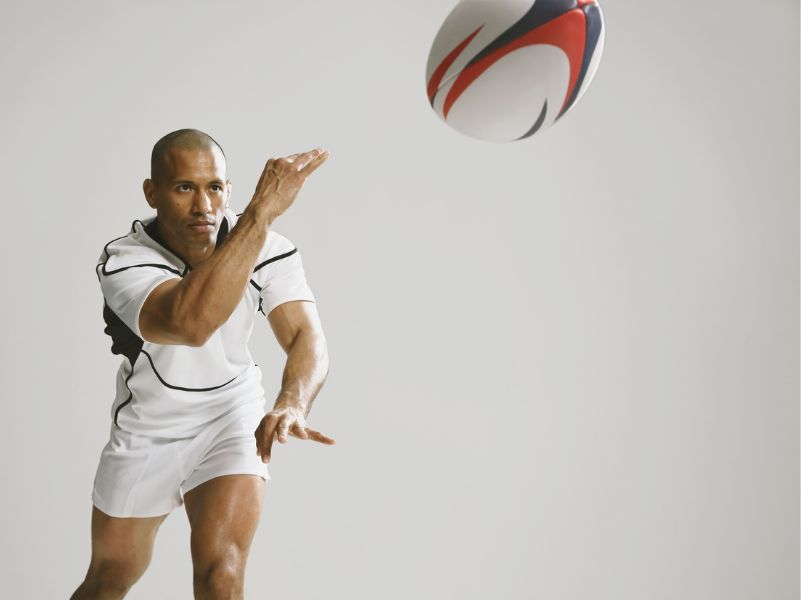
Clubhead speed is the single largest predictor of driving distance in golf. Every 1 mph increase in clubhead speed produces approximately 2.5 to 3 yards of additional carry distance. For most amateur golfers swinging between 85 and 95 mph, a 5 mph gain translates to 12 to 15 yards—the difference between hitting a 7-iron into a green versus a 6-iron, or reaching a par-5 in two versus laying up.
The fastest way to increase clubhead speed is not more range time or swing changes. It’s rotational power training. Research published in the Journal of Strength and Conditioning Research demonstrates that golfers who incorporate medicine ball throws into their training programs improve clubhead speed by 3 to 7 mph over 8 weeks—gains that persist when training continues. The mechanism is straightforward: the golf swing is a rotational power movement, and medicine ball throws train the exact kinematic sequence (hips → thorax → arms → implement) required to generate maximum clubhead velocity.
This article breaks down the five essential medicine ball exercises that produce measurable clubhead speed gains, with detailed execution cues, programming guidelines, and common mistakes to avoid. These are not theory. These are evidence-based drills validated in peer-reviewed research and used by tour-level strength coaches. For more on the role nutrition plays in supporting strength training adaptations, see our complete guide to nutrition essentials for golfers.
1. Why Medicine Ball Throws Work: The Science of Rotational Power
The golf swing operates in the transverse plane—rotation around the vertical axis of the body. Unlike sagittal-plane movements (squats, deadlifts) or frontal-plane movements (lateral raises, side lunges), transverse-plane rotation requires coordinated activation of the obliques, glutes, lats, and hip rotators to generate torque through the kinetic chain.
Kinematic sequencing research using 3D motion capture has established that elite golfers generate clubhead speed through a proximal-to-distal sequence: the pelvis initiates rotation, followed by the thorax, then the lead arm, and finally the club. Peak angular velocities occur sequentially, with each segment reaching maximum speed slightly after the segment below it. This creates a ‘whip effect’ where energy transfers from larger, slower segments (hips) to smaller, faster segments (hands and club).
Medicine ball throws replicate this exact sequence. A rotational medicine ball throw begins with hip rotation, transfers force through the torso, and releases through the arms—the same kinematic chain as the golf downswing. Research by Lephart et al. (2007) demonstrated that an 8-week golf-specific exercise program including medicine ball throws improved clubhead speed by an average of 5.2 mph in recreational golfers. Torres-Ronda et al. (2011) reviewed the literature and concluded that rotational strength and power are critical determinants of clubhead speed, with medicine ball training being one of the most effective modalities for developing these qualities.
The physiological adaptation is twofold: (1) neural—improved rate of force development and motor unit recruitment in the rotational musculature, and (2) structural—hypertrophy of the obliques, glutes, and lats, which increases the force-producing capacity of the kinetic chain. Both adaptations translate directly to faster clubhead speed.
2. The 5 Essential Medicine Ball Exercises for Clubhead Speed
Exercise 1: Rotational Wall Throw (Bilateral Stance)
This is the foundational drill. It teaches proper hip-initiated rotation and torso-to-arm sequencing without requiring single-leg stability, making it appropriate for beginners.
Execution:
- Setup: Stand perpendicular to a solid wall, feet shoulder-width apart, holding a 6-10 lb medicine ball at chest height. Position yourself 3-4 feet from the wall.
- Wind-up: Rotate away from the wall (loading phase), shifting weight onto the back foot. Allow the hips to rotate first, followed by the torso. Keep arms relatively quiet—do not pull the ball back with the arms.
- Throw: Explosively rotate toward the wall, initiating with the hips. As the hips rotate, the torso follows, then the arms extend to release the ball into the wall. Catch the rebound and repeat.
- Cue: Think ‘hips → chest → arms → throw.’ The ball should leave your hands as a consequence of full-body rotation, not arm extension alone.
Exercise 2: Rotational Side Throw (Bilateral Stance)
Similar to the wall throw but releases the ball into open space, which allows for maximum velocity development and more closely mimics the golf release.
Execution:
- Setup: Stand in athletic position (slight knee bend, weight on balls of feet), holding a 6-10 lb medicine ball. Face perpendicular to your throwing direction.
- Wind-up: Rotate away from the throwing direction, loading the back hip and allowing the torso to coil. Arms stay connected to the torso—do not separate the ball from the body during the load.
- Throw: Explosively uncoil, driving through the hips first. Allow the torso to whip through, then release the ball at maximum velocity. Follow through fully, finishing with weight on the front foot.
- Cue: ‘Fast hips, whip the torso, throw through the target.’ Do not decelerate the rotation after release.
Exercise 3: Step-and-Throw (Single-Leg Finish)
Adds a dynamic weight shift, which increases power output and more closely replicates the weight transfer in the golf swing.
Execution:
- Setup: Begin in a staggered stance (back foot slightly behind front foot), holding the medicine ball.
- Step and load: Step back with the trail leg while simultaneously rotating away from the throwing direction. Weight shifts fully onto the back leg.
- Drive and throw: Explosively drive off the back leg, stepping forward and rotating through. The step initiates the kinetic chain, followed by hip rotation, torso whip, and arm release.
- Cue: ‘Step, drive, rotate, release.’ The step should be explosive, not passive.
Exercise 4: Overhead Rotational Slam
Trains the downswing pattern more specifically by starting from an elevated position and slamming the ball through the ground. Emphasizes deceleration strength and full-body integration.
Execution:
- Setup: Hold medicine ball overhead, arms extended, feet shoulder-width apart.
- Wind-up: Rotate the ball overhead to the trail side (right side for right-handed golfers), loading the back hip.
- Slam: Explosively rotate and slam the ball into the ground in front of the lead foot. The motion should mimic a golf downswing: hips fire first, torso rotates through, arms follow.
- Cue: ‘Throw the ball through the ground.’ Maximum velocity at impact, not at the start.
Exercise 5: Partner Rotational Toss (Reactive)
Introduces a reactive element, where the athlete must catch and immediately redirect a thrown ball. This trains rate of force development and improves stretch-shortening cycle efficiency in the rotational musculature.
Execution:
- Setup: Stand perpendicular to a partner, 8-10 feet apart, in athletic stance.
- Catch: Partner throws medicine ball to your chest. Catch it while rotating slightly in the direction of the throw (eccentric loading).
- Throw: Immediately reverse direction and throw the ball back to your partner with maximum velocity. The transition from catch to throw should be as brief as possible—minimize ground contact time.
- Cue: ‘Catch and explode.’ The faster the reversal, the greater the power output.
Supporting Video Resources
Medicine Ball Rotation Throw | Nuffield Health
How to Properly Execute Rotational Med Ball Throws | CrossFit Invictus
3. Programming Guidelines: Sets, Reps, Load, and Frequency
Rotational power training is neurally demanding. The goal is maximum velocity on every rep, which means sets and reps must be kept low to avoid fatigue-induced speed decrements.
Training Parameters
- Load: 6-10 lbs for most golfers. Heavier loads (12-15 lbs) can be used for strength-focused phases, but speed of movement decreases. Lighter loads (4-6 lbs) maximize velocity but reduce force output. The optimal load is one that allows maximum intent without compromising technique.
- Sets and reps: 3-5 sets of 3-5 reps per side. Each rep should be maximum effort. Rest 2-3 minutes between sets to allow full neurological recovery. If velocity decreases across sets, end the session.
- Frequency: 2-3 sessions per week. Space sessions at least 48 hours apart to allow recovery. Medicine ball training can be performed on the same day as lower-body strength training but should precede it (perform power work before strength work).
- Progression: Week 1-2: Learn the patterns with lighter loads (4-6 lbs), focusing on sequencing. Week 3-4: Increase load to 8-10 lbs and emphasize velocity. Week 5-8: Maintain load and volume, continue pushing maximum velocity. Reassess clubhead speed at Week 8.
Sample Training Week
Monday: Rotational medicine ball throws (Exercises 1, 2, and 3), 3 sets of 4 reps per side, followed by lower-body strength training (squats, deadlifts).
Wednesday: Reactive medicine ball work (Exercise 5), 4 sets of 3 reps per side, followed by upper-body strength training (bench press, rows).
Friday: Overhead slams (Exercise 4) and step-and-throw (Exercise 3), 3 sets of 5 reps per side, followed by golf-specific mobility work.
On-course practice: 2-3 sessions per week, focusing on transferring increased speed into controlled ball striking. TrackMan or similar launch monitor data is essential for validating speed gains.
4. Common Mistakes That Limit Results
Mistake 1: Arm-Dominant Throwing
The most common error. Golfers with poor rotational sequencing will initiate the throw by extending the arms rather than rotating the hips. This produces a ‘push throw’ instead of a rotational throw. The ball velocity will be low, and the training effect will be minimal.
Fix: Deliberately slow down the wind-up phase. Focus entirely on hip initiation. Think ‘hips move first, everything else follows.’ If necessary, perform the drill without releasing the ball—just rotate through and hold the finish position. Once sequencing is correct, add the throw.
Mistake 2: Inadequate Rest Between Sets
Power training is not conditioning. Performing medicine ball throws with short rest intervals (30-60 seconds) turns the drill into a metabolic challenge, which compromises velocity. If velocity drops across sets, the training stimulus is lost.
Fix: Rest 2-3 minutes between sets. Use this time to reset mentally, not to perform other exercises. Track velocity using a radar gun or video analysis if possible. If velocity drops by more than 10% from set 1 to set 3, end the session.
Mistake 3: Using Too Heavy a Load
A 20 lb medicine ball will produce high force output, but velocity will be low. The golf swing is a high-velocity movement (clubhead speed exceeds 100 mph for many amateurs). Training needs to be velocity-specific, not just force-specific.
Fix: Use loads that allow maximum velocity. For most golfers, 6-10 lbs is optimal. If the ball feels ‘slow’ off the hands, reduce the weight.
Mistake 4: No Transfer Work
Medicine ball training improves rotational power, but the improvement must transfer to the golf swing. Some golfers train explosively in the gym but swing conservatively on the range, which limits transfer.
Fix: After medicine ball sessions, perform 10-15 swings with a speed training aid (overspeed stick, light club, or driver) at maximum intent. This creates a neuromuscular bridge between gym training and on-course performance.
5. Measurable Performance Expectations and Validation
Based on peer-reviewed research and practical coaching experience, golfers who consistently perform rotational medicine ball training should expect the following gains over an 8-week training block:
| Metric | Baseline (Typical Amateur) | 8-Week Gain (Expected) |
| Clubhead Speed | 85-95 mph | +3-7 mph |
| Ball Speed | 125-140 mph | +4-10 mph |
| Carry Distance | 220-240 yards | +10-18 yards |
| Rotational Med Ball Throw Velocity | Baseline (measure Week 1) | +15-25% |
Validation is essential. Use TrackMan, FlightScope, or another launch monitor to measure clubhead speed at baseline (Week 0), midpoint (Week 4), and endpoint (Week 8). Gains should be progressive. If clubhead speed stalls or decreases, reassess training volume, rest intervals, and technique.
Medicine ball throw velocity can be measured using a radar gun (Stalker, Pocket Radar) pointed at the ball during release. Increases in medicine ball velocity typically precede increases in clubhead speed by 1-2 weeks, making it a useful leading indicator of training efficacy.
The research is consistent: properly programmed rotational power training produces measurable, transferable gains in clubhead speed. Lephart et al. (2007) reported an average increase of 5.2 mph over 8 weeks. Alvarez et al. (2012) observed similar improvements in low-handicap golfers following an 18-week strength and power program that included medicine ball work. The adaptations are neural first (improved motor unit recruitment and rate coding), followed by structural (hypertrophy of rotational musculature) if training continues beyond 8-12 weeks.
Final Word
Medicine ball training is not a substitute for sound swing mechanics or consistent practice. But for golfers who already move well and are looking for the next marginal gain, rotational power training is the highest-ROI investment you can make. Three sessions per week, 20 minutes per session, for 8 weeks will produce measurable increases in clubhead speed—gains that translate directly to additional carry distance and lower scores.
The five exercises outlined here—rotational wall throws, side throws, step-and-throws, overhead slams, and reactive partner tosses—cover the full spectrum of rotational power development. Start with bilateral stance drills to learn sequencing, progress to dynamic weight-shift drills to increase power output, and incorporate reactive work to maximize rate of force development.
Track your progress. Measure clubhead speed every two weeks. Record medicine ball throw velocities. If the numbers aren’t moving, adjust the variables: load, rest, frequency, or technique. The research validates the method. Your job is to execute it consistently and measure the outcome. For Connecticut golfers with simulator access, there’s no excuse not to validate these gains in real time by incorporating these 6 proven exercises to increase golf clubhead speed.
Sources: Lephart SM, Smoliga JM, Myers JB, Sell TC, Tsai YS. An eight-week golf-specific exercise program improves physical characteristics, swing mechanics, and golf performance in recreational golfers. Journal of Strength and Conditioning Research. 21:860–869, 2007. | Torres-Ronda L, Sanchez-Medina L, Gonzalez-Badillo JJ. Muscle strength and golf performance: a critical review. Journal of Sports Science and Medicine. 10:9–18, 2011. | Alvarez M, Sedano S, Cuadrado G, Redondo JC. Effects of an 18-week strength training program on low-handicap golfers’ performance. Journal of Strength and Conditioning Research. 26:1110–1121, 2012.

David is an avid golfer who loves walking Connecticut’s courses and playing alongside his family. He’s passionate about golf course architecture and one day hopes to play at Pebble Beach.