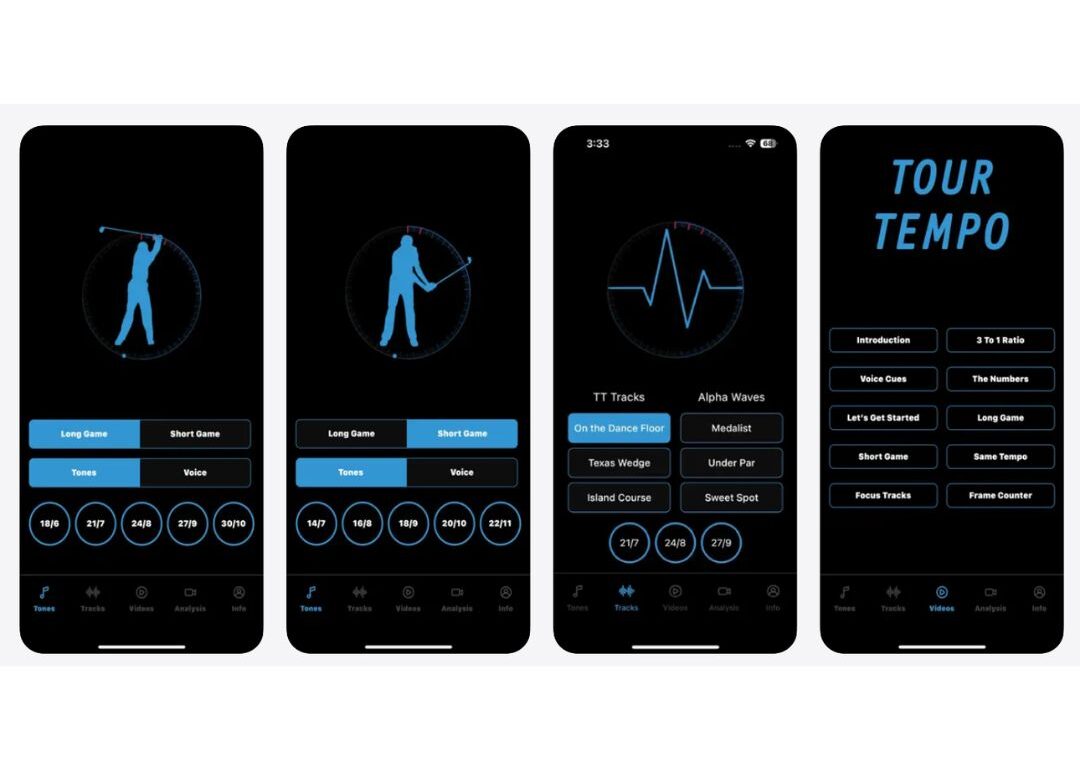
I spent two years chasing distance before I realized my real problem was consistency. My TrackMan numbers told the story: swing speed varied by 8 mph shot to shot, launch angle fluctuated wildly, and my dispersion pattern looked like a shotgun blast. The issue wasn’t my swing mechanics—it was that I had no swing mechanics. Every rep was a different tempo, a different rhythm, a different timing sequence. The Tour Tempo app helped to improve that. I first heard about this app from the Wicked Smart Golf podcast, and have really liked it after buying it. Based on research by John Novosel analyzing thousands of tour player swings, the app trains you to match proven tempo ratios—specifically the 3:1 ratio used by most tour pros with driver. Three frames from takeaway to top of backswing, one frame from top to impact. The app uses audio tones to mark these positions, giving you an external metronome to lock in repeatable timing.
After six weeks of training with Tour Tempo while tracking progress on TrackMan, my driver dispersion dropped from an average of 42 yards offline to 25 yards. Swing speed consistency tightened from ±8 mph to ±2 mph. Smash factor climbed from 1.42 to 1.48. Most importantly, my misses became predictable. This is the protocol I built and how to implement it yourself.
Understanding Tour Tempo Ratios
Tour Tempo is built on frame-count analysis of professional swings filmed at 30 frames per second. The research found that tour players cluster around specific timing ratios regardless of their overall swing speed. For driver, the dominant ratio is 3:1—meaning the backswing takes three times as long as the downswing. In absolute time, this typically translates to 27 frames total: 21 frames from start to top, 6 frames from top to impact. At 30 fps, that’s 0.70 seconds backswing, 0.20 seconds downswing, 0.90 seconds total. The app offers multiple tempo options—24/8 (faster, more aggressive), 27/9 (tour standard), and 30/10 (slower, more controlled). Each maintains the 3:1 ratio. There’s also a 2:1 ratio option (18/9) used by some players with irons, but for driver work, I recommend starting with 27/9. It matches the statistical mode of tour swings and provides enough backswing time to load properly without rushing the transition.
The great thing of the system is that it doesn’t care about your swing mechanics. You can swing flat or upright, one-plane or two-plane, strong grip or weak grip—the tempo ratio works regardless. What it fixes is the timing variable that most amateurs never address. We spend hours on swing path and face angle and ignore the fact that our swing takes a different amount of time every single rep.
The 6-Week Tour Tempo and TrackMan Protocol
This protocol layers tempo training into your existing practice while using TrackMan to validate improvements in consistency. Weeks 1-2 focus on ingraining the audio tones without a ball. Weeks 3-4 introduce ball striking with tempo focus. Weeks 5-6 integrate tempo into full TrackMan sessions and dial in your optimal frame count. Each session takes 20-30 minutes. Four sessions per week is ideal, but three will work.
The key is separating tempo acquisition from ball striking initially. If you try to match the tones while worrying about contact quality, you’ll subconsciously adjust your tempo to “save” bad swings. Build the timing pattern first in a zero-pressure environment, then layer in the ball.
Tour Tempo Training Protocol by Week
| Week | Training Focus | Reps |
| 1 | No ball. Practice swings only with 27/9 tones. Focus on hearing all three beeps (start, top, impact). Use alignment stick or club. | 30-40 |
| 2 | Continue no-ball work. Add ‘eyes closed’ drill for 10 reps. Establish baseline TrackMan session (20 drivers, no tempo focus). | 30-40 |
| 3 | Introduce ball. 5 tempo-only swings (no ball), then 10 balls with tones. Accept mishits. Track on TrackMan. | 15 |
| 4 | Full TrackMan session with tones. 20 drivers. Compare dispersion and consistency metrics to Week 2 baseline. | 20 |
| 5 | Test alternate tempos: try 24/8 (faster) and 30/10 (slower). Hit 8 balls each. Compare TrackMan metrics. | 24 |
| 6 | Lock in optimal tempo. Full 25-ball TrackMan session with your best-performing tempo. Wean off tones for final 5 swings. | 25 |
How to Use the Audio Tones During Practice
The Tour Tempo app plays three tones per swing. Tone 1 marks your takeaway start. Tone 2 marks top of backswing. Tone 3 marks impact. For the 27/9 setting, you’ll hear a rhythm that sounds roughly like: beep… beep… BEEP. The first two tones are spaced further apart (the backswing), the final tone comes quickly after the second (the downswing). Start each rep by pressing play, then beginning your swing on the first tone. Don’t try to match the tones consciously—just let them play and swing naturally while listening. After 10-15 reps, your nervous system will start syncing to the rhythm automatically. You’ll feel yourself ‘waiting’ for the second tone at the top and releasing on cue when the third tone fires.
The most common mistake is trying to force the match. If you consciously slow down or speed up to hit the tones, you’ll create mechanical compensation patterns. Instead, swing freely and notice where your natural timing falls relative to the tones. Early in Week 1, you might be consistently late to the top (hitting your actual top position after tone 2) or rushing the downswing (impacting before tone 3). That’s fine. The feedback loop is what trains the adjustment.
TrackMan Metrics to Track for Tempo Optimization
Tempo training isn’t about hitting it farther—it’s about hitting it the same. The TrackMan metrics that matter most are consistency and predictability, not peak performance. Here’s what to monitor:
- Swing Speed Standard Deviation: Your goal is ±2 mph or less across a 20-ball session. Pre-tempo, mine was ±8 mph. Post-tempo: ±1.8 mph.
- Lateral Dispersion (offline distance): Measure how far left or right your shots finish from centerline. Pre-tempo average: 42 yards. Post-tempo: 25 yards.
- Launch Angle Consistency: Should stay within ±2 degrees. Wild variance indicates inconsistent delivery. Mine tightened from ±4.5° to ±1.8°.
- Smash Factor: This will improve as strike quality becomes more consistent. Target 1.48+ with driver. Mine improved from 1.42 to 1.48 average.
- Spin Rate Variance: Should cluster within ±300 RPM. Tempo fixes delivery path, which stabilizes dynamic loft and attack angle.
In Week 2, establish your baseline by hitting 20 drivers without the app—just your natural swing. Record all five metrics. Then in Week 4 and Week 6, repeat the 20-ball session with tempo tones active and compare. The improvement in standard deviation and dispersion is where tempo makes its case.
Supporting Video Resources
Master the 3:1 Ratio: Gain Speed and Consistency with Tour Tempo
The Simple Secret to Carrying Your Driver 300+ Yards
Common Tempo Mistakes and How to Fix Them
Mistake 1: Starting the app mid-swing
The tones only work if you start moving on tone 1. If you press play and then wait to swing, you’ll be chasing the rhythm instead of syncing to it. Press play, hear tone 1, start your takeaway. The timing should feel like: tone = move, not move = tone.
Mistake 2: Forcing mechanical changes to match the tones

Don’t artificially slow your backswing or rush your downswing. Swing naturally and let the mismatch reveal itself. Your body will adjust over reps. If you consciously manipulate tempo, you’ll build compensation patterns that fall apart under pressure.
Mistake 3: Jumping straight to ball striking
Week 1 exists for a reason. If you skip the no-ball reps, you’ll be managing two learning curves simultaneously—tempo matching and strike quality. Separate them. Build the tempo pattern in a zero-consequence environment first.
Mistake 4: Sticking with one tempo without testing alternatives
The 27/9 setting is the statistical mode, but it’s not universal. Some players naturally swing faster or slower. Week 5 is designed to test this. Hit balls with 24/8 and 30/10 and see which produces better TrackMan consistency. The right tempo is the one where your metrics tighten, not the one that “feels” right.
Final Word
The Tour Tempo app costs $24.99. A single TrackMan session at most facilities in Connecticut runs $40-60 (or free if you have a membership at Golf Lab CT). Total investment for this protocol: under $300 if you’re paying for range time and TrackMan access. The ROI isn’t measured in yards gained—it’s measured in fairways hit, greens in regulation, and strokes saved from eliminating the catastrophic miss.
Tempo is the invisible variable in the golf swing. You can’t see it on video. It doesn’t show up in a mirror. But it governs everything—transition timing, sequencing, strike quality, consistency. The Tour Tempo app makes the invisible visible by giving you an external reference point. The TrackMan validates that the timing improvements are transferring to ball flight.
I’ve used this protocol twice now—once in the fall and once during an off-season reset. Both times, the dispersion numbers improved by 35-40%. Both times, the consistency metrics tightened significantly. And both times, the gains carried into actual rounds. If you’ve ever felt like your swing is different every day, like you don’t know which version of yourself is showing up on the first tee, tempo training is the answer. It won’t make you longer. But it will make you the same. And in golf, being the same is often better than being great.

David is an avid golfer who loves walking Connecticut’s courses and playing alongside his family. He’s passionate about golf course architecture and one day hopes to play at Pebble Beach.