

I’ll admit it—I’m a tinkerer. Over the years, I’ve spent countless hours on the range obsessing over swing plane, wrist hinge, hip rotation, and every other mechanical detail you can imagine. My head was so full of swing thoughts that I could barely get the club back without analyzing three different positions. Sound familiar? Then I listened to the Wicked Smart Golf podcast featuring John Novosel Jr., co-creator of Tour Tempo, and the concept intrigued me enough to give it a shot. I bought the Tour Tempo app for $25—which honestly feels a bit overpriced for what’s essentially a sophisticated metronome—but at least there’s no subscription fee. I’ve only been using it for a few days, so it’s early, but I’m curious to see how this plays out. So far, I think it provides more value than some of my other training aids that are collecting dust in the garage.
The Core Concept
John Novosel analyzed frame-by-frame video footage of professional golfers and noticed a pattern: nearly every great golfer throughout history—from Ben Hogan to Tiger Woods, Jack Nicklaus to Scottie Scheffler—shares the same tempo ratio of 3:1 (backswing to downswing). Some pros swing faster and others slower, but virtually all of them maintain that 3:1 ratio. Wyndham Clark swings at 18:6, Adam Scott at 21:7, and Scottie Scheffler at 24:8—all maintaining the same 3:1 tempo despite different overall speeds. Scientists at Yale University later conducted an independent study and confirmed Novosel’s findings, publishing their results in “A Biomechanical Understanding of Tempo in the Golf Swing.”
Tour professionals swing with elapsed times between 0.93 to 1.20 seconds from takeaway to impact, while amateurs typically range from 1.3 to 3.0 seconds. Most recreational golfers swing considerably slower, often influenced by the old “low and slow” mantra that’s been passed down for generations. According to the theory, when the tempo is right, there isn’t time left over for the club to do all the inefficient things it usually does during bad swings—like pausing, hitching, wandering in loops, or coming over the top. The app plays three tones that guide your swing: start your backswing on the first beep, reach the top of your backswing on the second beep, and make impact on the third beep. If you choose the voice option, you’ll hear “Swing, set, through”—swing means start your backswing, “set” is when you set the club at the top, and “through” is your finish.
Understanding Long Game vs. Short Game Ratios
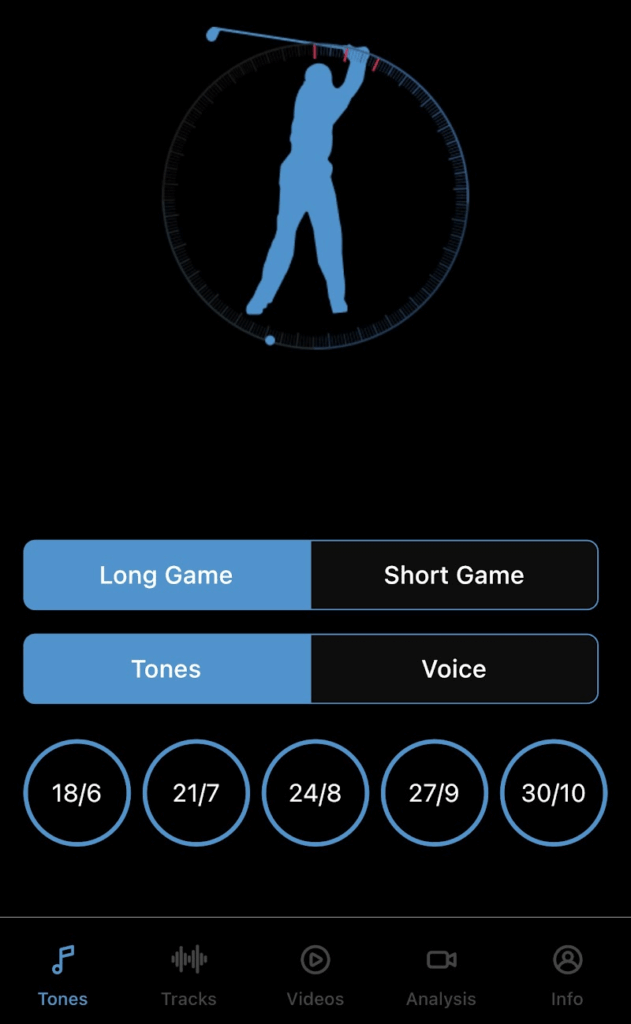
The Tour Tempo app separates your game into two distinct categories, each with its own optimal tempo ratio. For your long game—driver through mid-irons—the app uses the 3:1 ratio with frame options of 18/6, 21/7, 24/8, 27/9, and even 30/10 for those still working on speeding up their tempo. These numbers represent video frames at 30 frames per second, so a 21/7 tempo means 21 frames (0.70 seconds) for your backswing and 7 frames (0.23 seconds) for your downswing, totaling just 0.93 seconds from takeaway to impact. Most golfers are surprised when they realize how fast tour pros actually swing—it only looks smooth and effortless on TV because of the consistent tempo ratio.
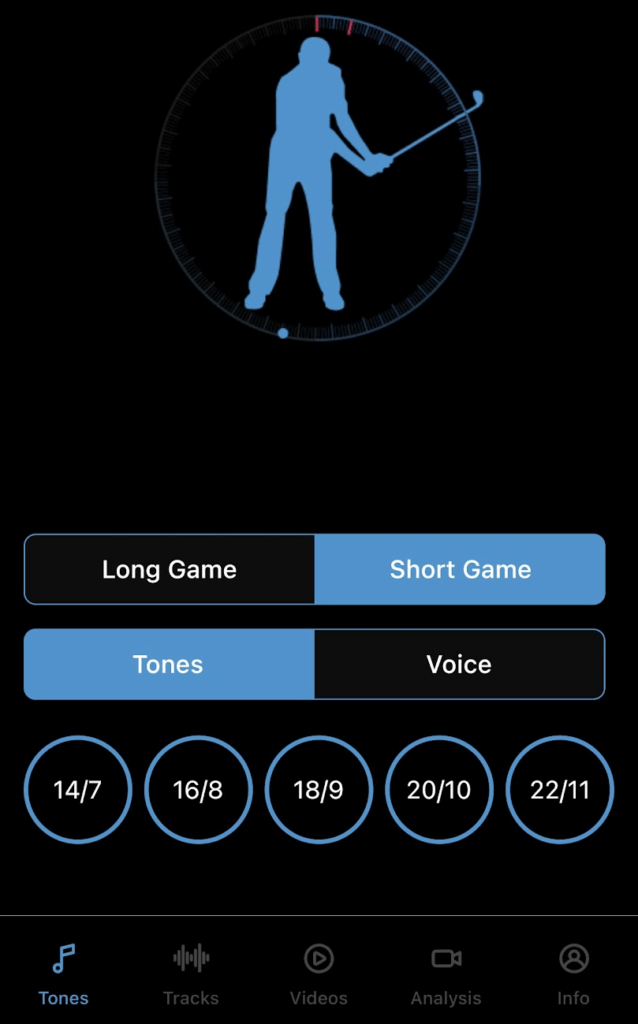
For your short game—pitching, chipping, and putting—the app shifts to a 2:1 ratio with options like 14/7, 16/8, 18/9, 20/10, and 22/11. John Novosel discovered this after studying the short game swings of top touring pros and found that virtually all of them employ a different tempo around the greens than they do with full swings. This makes intuitive sense: you need more control and feel on delicate shots, and the 2:1 ratio provides that while still maintaining the consistency that comes from having a set tempo. You can switch between long game and short game modes in the app depending on what you’re practicing, and the tones automatically adjust to guide you through the appropriate ratio.
How to Choose Your Ideal Tempo (Accuracy vs. Distance vs. Dispersion)
One of the most common questions is: which tempo should I use? The answer isn’t one-size-fits-all, and understanding the tradeoffs between the different ratios will help you make the right choice for your game. Generally speaking, faster tempos (18/6, 21/7) tend to produce more distance because you’re generating more clubhead speed, but they can also lead to wider dispersion patterns if you’re still developing the consistency. Think of players like Rory McIlroy who swing at 21/7—they bomb it, but they need elite hand-eye coordination to keep it in play. Mid-range tempos (24/8, 27/9) offer the best balance between distance and accuracy for most amateur golfers. Tiger Woods has played at both 27/9 and 21/7 at different points in his career, and Fred Couples built a Hall of Fame career on a 24/8 tempo. These tempos give you enough speed to be competitive while providing a slightly longer window to square the clubface and make solid contact.
Slower tempos (27/9, 30/10) maximize accuracy and tightness of dispersion at the expense of some distance. If you’re fighting a big slice or pull-hook, starting with a slower tempo can help you find the center of the clubface more consistently before graduating to a faster tempo. Many golfers report that their “money tempo” is faster than they initially think—though I’m still in the early stages of figuring out what works best for me. The app recommends experimenting: spend a practice session trying each tempo option with the same club and track your results. Use a launch monitor if you have access to one, or simply note your carry distances and where your misses go. The idea is that a faster tempo might actually reduce dispersion because it eliminates the “extra time” where swing faults can creep in—though I haven’t been using it long enough to confirm that from personal experience.
It’s also worth noting that your ideal tempo might change based on the situation. The theory is that you could use a faster tempo like 21/7 for full swings when you need distance, but dial it back to 24/8 on tight driving holes where accuracy is paramount. For short game work, the app suggests experimenting with different 2:1 ratios to find what feels right. I’m still early in the process of figuring out my preferences, but the app makes it easy to switch between ratios on the fly once you settle on what works.
What You Should Be Doing on Each Tone (Including Footwork and Hip Movement)
Here’s a practical breakdown of what happens on each of the three tones, including the critical lower-body movements that create power and consistency:
| Tone | What You Should Be Doing |
|---|---|
| First Tone (Start) | Begin your takeaway immediately. The club should start moving away from the ball smoothly and naturally. Don’t overthink it—just respond to the tone and let your body initiate the backswing. This is your trigger to go. Your weight begins shifting to your trail foot (right foot for right-handers), and your hips start turning naturally. For short game shots, this is when you begin your backswing motion with minimal lower body movement—it’s much more arms and shoulders around the greens. |
| Second Tone (Top/Set) | You should be at the top of your backswing, with the club fully set. This is the critical transition point where power is created. On this tone, your lead foot (left foot for right-handers) should stomp or replant firmly into the ground—think of it as an active “plant and push” move that loads the ground for explosive power. Your hips should be coiled and ready to fire, with your weight loaded into the inside of your trail foot. When you match this tone, your transition happens automatically without conscious effort. This isn’t a pause—it’s the moment where your lower body starts driving toward the target while your upper body is still completing the backswing, creating that powerful separation. For short game shots, there’s minimal foot action—just a subtle weight shift. |
| Third Tone (Through/Impact) | This is when you make contact with the ball and follow through. Your hips should be firing explosively through impact—they started the downswing motion at tone 2 and are now fully rotated toward the target by tone 3. Your club should be striking the ball precisely on this tone, with your lead foot firmly planted and pushing against the ground for leverage. Your trail heel will naturally lift as your hips clear and your weight transfers completely to your lead side. The momentum from the proper tempo carries you through to a balanced finish. You’re not trying to “hit” at impact—the tone guides you through impact naturally as part of one continuous motion driven by your lower body rotation. For short game shots, the hip rotation is much more subtle—you’re using mostly your upper body with just a slight weight shift through the ball. |
Key Insight: The point isn’t hitting each position perfectly—it’s surrendering to the rhythm and letting the tones guide your body through one fluid motion. When you sync with the tempo, those mechanical positions you’ve been obsessing over tend to happen naturally. The left foot stomp at tone 2 and the hip fire through tone 3 happen instinctively when you’re not trying to control every aspect of the swing. This is especially true for the long game—your lower body becomes the engine that drives the swing, while the tones ensure everything happens in the right sequence and at the right speed.
Why This Might Clear Mental Clutter (Early Impressions)
Here’s what’s interesting about Tour Tempo, and what John Novosel Jr. emphasized in the podcast: it theoretically eliminates the need for mechanical swing thoughts. When you’re focused on matching three simple tones, there’s no mental bandwidth left for “keep your left arm straight,” “maintain lag,” “don’t come over the top,” or any of the hundreds of other instructions we torture ourselves with. The tempo is supposed to create the correct mechanics naturally—at least that’s the theory. As one user put it: “This is the best product out there to help with tempo and get your mind free of swing thoughts.” A teaching pro shared how he used it with his father, who was a victim of over-thinking and over-coaching with a painfully slow swing. After introducing the Tour Tempo tones, the next five balls were laser straight and long. Those are compelling testimonials, though I’m cautious about putting too much stock in individual success stories.

I’ve only been using the app for a few days now, so I can’t claim any dramatic transformation yet. But I will say that having something to focus on besides my usual mental checklist has been interesting. Instead of standing over the ball running through seven different swing thoughts, I now take my setup, hear the tones in my head (or through my earbuds during practice), and try to match the rhythm. It’s a different approach, and I’m genuinely curious to see if this holds up over time or if it’s just the novelty effect. The goal—if this actually works long-term—is to reach the point where the tempo becomes automatic, the way tour pros don’t think about it because it’s deeply embedded in their muscle memory. But I’m only a few range sessions in, so we’ll see.
Is $25 steep for what amounts to an advanced metronome? Probably. You can find basic metronome apps for free or a couple of bucks. But to Tour Tempo’s credit, there’s no monthly subscription trying to nickel-and-dime you, and it does offer more structure than a generic metronome with the frame ratios, voice guidance, and video analysis tools. Compared to some of the training aids I’ve bought over the years that promised the world and delivered nothing, this at least feels like it’s grounded in actual research. The app also includes training tracks for focus and practice routines that I haven’t fully explored yet. The Titleist Performance Institute’s 3D research data, culled from analyzing tour pro swings, confirms that Tour Tempo is the only golf training aid validated by an independent scientific study. This isn’t just feel-good instruction—it’s based on measurable, repeatable data from the world’s best players. Whether that translates to better golf for the average amateur is the question I’m hoping to answer over the coming weeks.
If you’re someone who struggles with too many swing thoughts, inconsistent ball-striking, or a slow and labored swing tempo, Tour Tempo is an interesting concept worth considering. For the price of a couple sleeves of golf balls, you get access to a training method based on what tour pros actually do—not what someone thinks they should do. As one MyGolfSpy reviewer put it, they gave Tour Tempo a perfect score, writing: “Tour Tempo is scientifically proven, it’s easy to use, and it will help you in every facet of the game.” That’s high praise, though I’m always a bit skeptical of perfect scores for anything.
For now, I’ll say this: it’s an interesting concept, the research behind it seems solid, and after a few days of experimenting, I’m looking forward to seeing how it plays out. Three tones, one ratio, potentially less mental clutter. We’ll see if it delivers.
Have you tried Tour Tempo? What’s your experience with tempo training? Drop a comment below—I’d love to hear your thoughts!
David is an avid golfer who loves walking Connecticut’s courses and playing alongside his family. He’s passionate about golf course architecture and one day hopes to play at Pebble Beach.



love how this place doesn’t have a subscription