
Stratford Short Beach Golf Course is a public par-27 course measuring approximately 1,359 yards from the tips. The course was originally designed in 1988 by Geoffrey Cornish and Brian Silva and is located in Stratford, Connecticut.
It sits on fewer than 30 acres of dead-flat terrain adjacent to Long Island Sound. The routing is compressed and linear, with holes playing in tight succession across a constrained municipal site. Instead of dunes or native vegetation, the borders are framed by chain-link fences and homes on raised lots that peer down on the course. The design relies almost entirely on yardage variation, not strategic nuance. This is a venue for beginners or casual swings, not for players who appreciate centerline hazards, alternate angles, or well-shaped push-up greens.
Walkability
Short Beach is flat, compact, and physically effortless to walk. The routing flows quickly, and most green-to-tee distances are under 30 yards. With no elevation changes and few physical challenges, players can move through a loop in under an hour. But that simplicity comes with a cost. The walk lacks rhythm, progression, or moments of anticipation, and you’re always within view of surrounding homes, fences, or roads.
- Pro: The site’s flatness makes walking easy, and the low profile of the routing eliminates any strain between holes. However, that same flatness exposes the course’s sunken positioning, as nearly every neighboring house rises above it. From the fairways, you’re constantly looking upward at split-level colonials and vinyl-sided homes, which breaks immersion and creates a strange fishbowl effect. Holes 1 through 6 form a reasonably cohesive loop, with transitions of less than 30 yards and little directional confusion. This stretch is quick to walk and rarely crowded, making it suitable for beginners, older players, and families with kids. The terrain may lack inspiration, but the pace it enables is one of the few highlights.
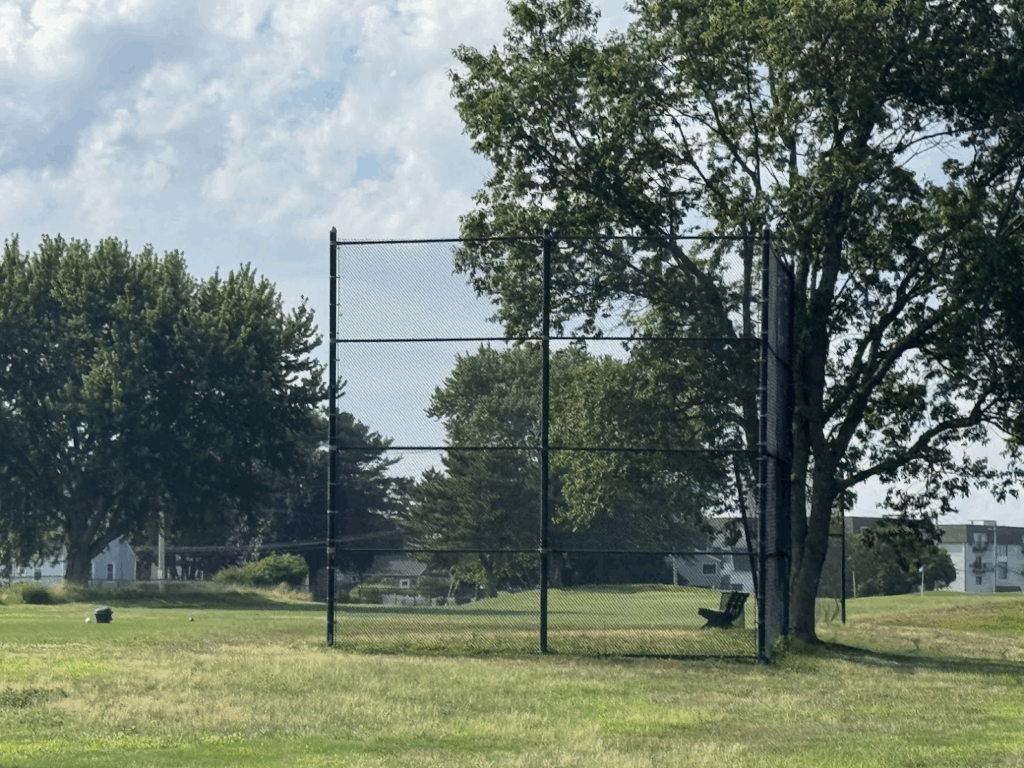
- Con + Fix: After finishing the green at Hole 7, the routing completely breaks down. You’re forced to walk 50 yards laterally, then 80 yards backward against the routing direction to reach the tee box for Hole 8. This is not just a minor inconvenience—it’s spatially incoherent. The experience is worsened by the imposing 30-foot industrial black fencing left of the 8th tee, a structure that looks more like a theme park containment wall than golf course protection netting. Presumably it exists to block shanks from 7, but its visual impact is extreme and jarring. A full rerouting of 7 and 8 is required to resolve this. I would reverse the orientation of 8 and reposition the 7th green to allow a more direct flow and eliminate the need for protective fencing entirely.
Strategic Test
Strategic engagement is minimal to nonexistent across the course. The majority of holes present centerline tee shots into moderately sized greens with little contour variation or positional advantage. Hazards are visible but rarely challenge decision-making. There are no meaningful angles of approach, no directional bunkers, and no incentive to shape a shot or adjust trajectory. The routing asks for no decisions beyond distance control.
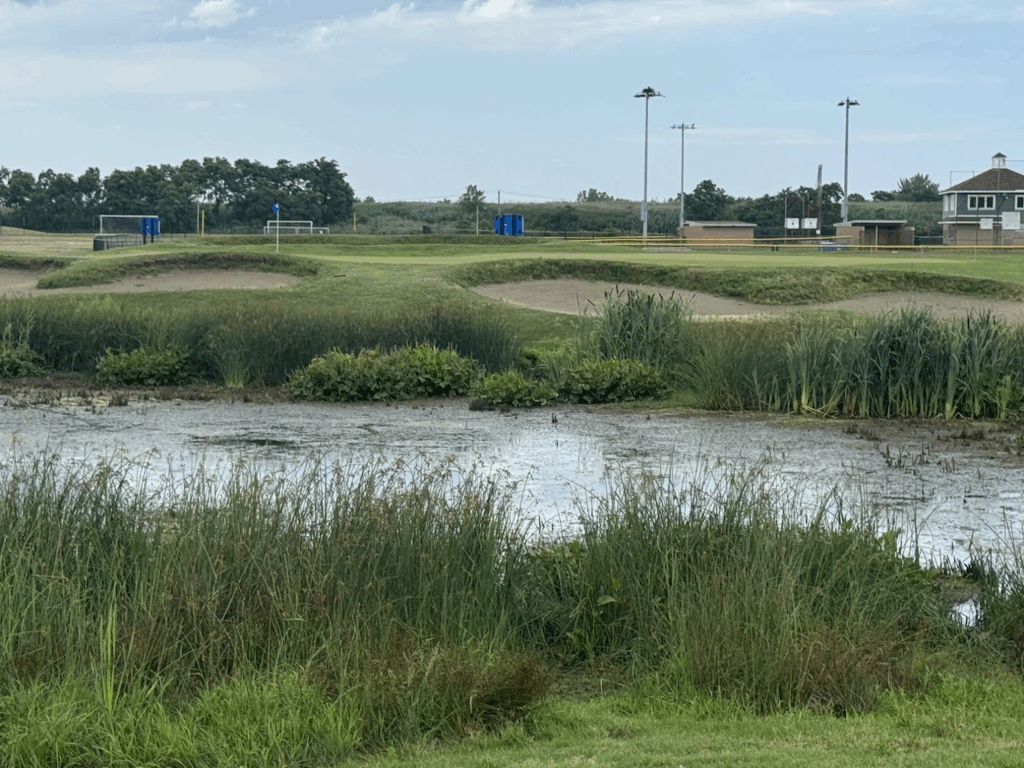
- Pro: Hole 3, measuring approximately 100 yards, is the only hole that flirts with legitimate strategy. The tee shot is completely blind due to a curtain of reeds that blocks the view to the green. That green is shallow and defended by bunkers short-left, short-right, and long. The entire front edge slopes off severely, and the internal contours divide it into three distinct tiers sloping right to left. From the tee, a weak but heroic carry over the scum-filled pond is required just to reach the surface. A bold player might take a lob wedge and fly it to the back shelf, flirting with the long bunker and hoping for spin. A safer player might attempt a bump-and-check shot to the front tier, aiming for an uphill two-putt. While the shot demands touch and elevation control, the surrounding visuals—rotting pond scum, patchy turf, and a backdrop of chain-link—undercut what could otherwise be a strong short hole. With proper maintenance and tee visibility, Hole 3 could be a standout. As is, it remains a rough sketch of potential.
- Con + Fix: Hole 2 is a template for monotony. It plays 164 yards with a single bunker left of the green and a straight corridor from tee to target. There is no differentiation from Hole 1 aside from length. The green orientation is identical. The fairway is just as flat. The hazard is in the same position. Walking up to the tee, I expected a subtle test to evolve from the opening hole. Instead, I was met with a carbon copy—only longer and more tiring. To remedy this, I would move the tee box 25 yards to the right, regrade the fairway to introduce a false front, and orient the green at a 45-degree angle from the tee. A single bunker set diagonally 20 yards short-left of the green would force players to choose a high shot over sand or a safer low shot to the right.
Playability
Short Beach is playable in the literal sense. You can swing freely without fear of losing balls or facing unplayable lies. The course doesn’t overwhelm with distance, and most targets are visible. But there’s a difference between accessibility and quality. Several holes actively confuse the player with poor sightlines, ambiguous hazards, and obstacles that create doubt rather than guidance.
- Pro: Hole 1 offers a gentler introduction to the round. It plays 135 yards with minimal hazard—the bunker right is shallow and easy to avoid. The green is broad, slopes gently from back to front, and holds shots well. It’s not a great hole, but it doesn’t punish inexperience and serves as the kind of simple target that beginners or juniors can approach with confidence.
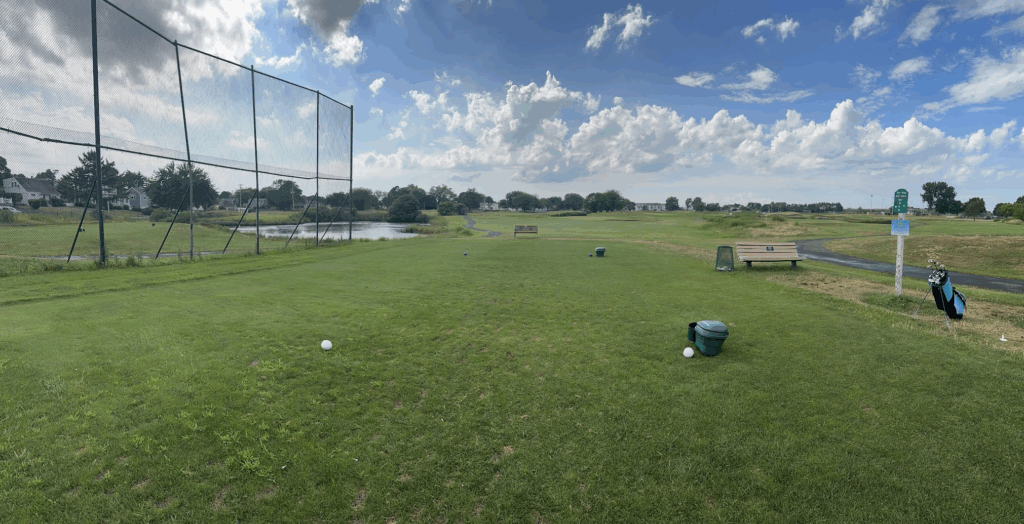
- Con + Fix: Hole 6 is almost cruel in its confusion. A metal bench is positioned directly in front of the tee box, obscuring the ideal line. I’m not sure if vandals moved it or if it was placed there by design, but either way, it’s inexcusable. A pond guards the left side and suggests a forced carry, but the actual green is off to the right, beyond a tangle of cart paths and indifferent turf. The visual message implies one shot, but the actual line rewards a different one. Beginners are likely to misread the hole entirely and either chunk into the pond or bounce off concrete. To fix this, I would remove the bench, clean up the hardscape, and reorient the green to sit behind the pond. With that single shift, the hole would become a true forced carry, requiring a clean strike but rewarding it clearly.
Atmosphere
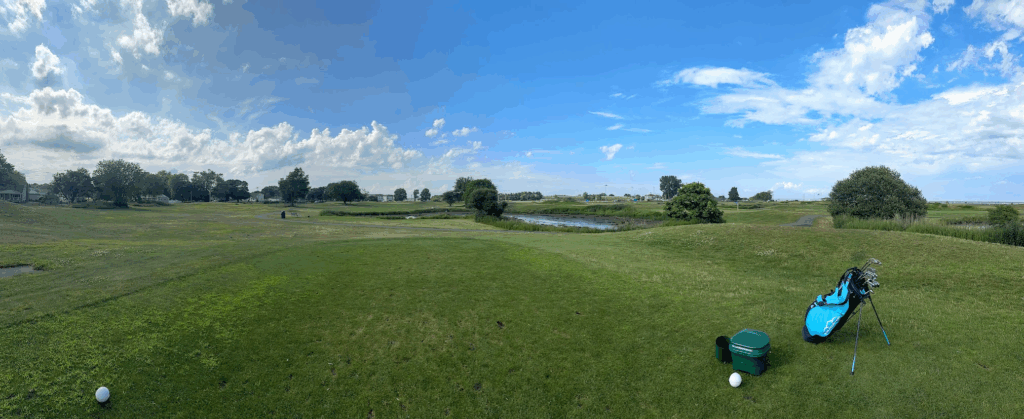
For a course positioned just yards from the Long Island Sound, Short Beach offers almost none of the sensory pleasure one would expect. Instead of ocean breezes and coastal charm, you get chain-link fencing, invasive weeds, and the smell of pond sludge. The setting is a reminder that proximity to beauty is meaningless without proper stewardship.
- Pro: Hole 4 is the lone exception—a glimpse of what could have been. The hole plays parallel to the water, with a raised green that catches sunlight and a small moment of sky that feels expansive. You can hear the waves, smell salt in the air, and see beyond the clutter. For one brief stretch, the routing opens up and reminds you that you are near the coast. But it’s fleeting. The next tee box quickly restores the course’s visual and sensory clutter.
- Con + Fix: Hole 9 is the most disappointing hole on the property, and perhaps the most heartbreaking. On paper, it looks like a perfect closer—125 yards, framed by three bunkers (one short-front, one short-right, and one behind), with a pond bisecting the tee shot and a wide green that invites different approaches. In reality, the pond was nearly dry and smelled foul. The bunkers were unkempt, and the green site was surrounded by decay. The air reeked, the turf was cracked, and I hit my ball into the bunker and walked off without even finishing the hole. This was the hole I had looked forward to the most after seeing aerials. It could have been an exclamation point to the round. A center-cut 9-iron or a feathery wedge would be ideal, depending on the wind, with the best line slightly left to avoid the right trap. The carry over the pond offers a visual test and would frame the green beautifully if the water level were maintained. Restoring this hole could restore the course’s finish—but right now, it’s a final note of frustration.

Final Word
I came to Short Beach with measured expectations and left deeply disappointed. The course has all the bones of something special—short distances, a coastal setting, and a compact footprint—but it squanders every opportunity to offer a memorable or enjoyable round. Instead, it presents disjointed routing, decaying infrastructure, and architecture that ranges from indifferent to incoherent.
There was trash scattered around the property, including a crushed Doritos bag near one tee and a half-buried Snickers wrapper by a green. These weren’t one-off anomalies—they were symptoms of broader neglect. It’s rare to see a public course this close to the ocean, with architectural lineage from Cornish and Silva, in such visual and conceptual disrepair.
By comparison, nearby options like the Carl Dickman or Tashua Glen are lightyears ahead in both design and conditioning. Those courses offer decision points, clean turf, and visuals that invite play. Short Beach offers none of that. It is, sadly, the worst maintained and most disappointing executive course I’ve played.
If I owned this property, I would level it and rebuild a minimalist short course with sand-based greens, fescue rough, and an aesthetic rooted in the site’s coastal identity. Until that happens, this is a case study in missed opportunity. I won’t be back until someone hits it with a bulldozer.

David is an avid golfer who loves walking Connecticut’s courses and playing alongside his family. He’s passionate about golf course architecture and one day hopes to play at Pebble Beach.